
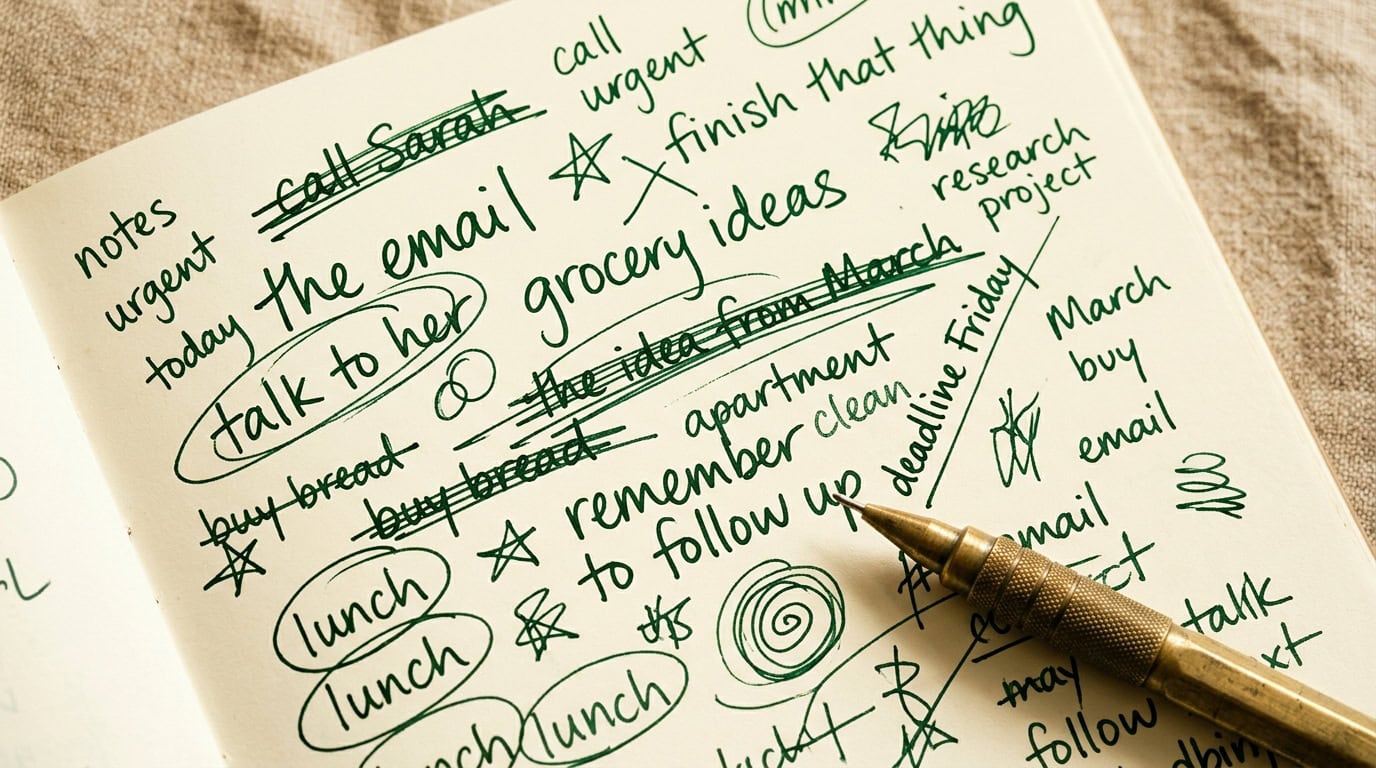
Your brain has been running tabs for months. Not the browser kind — the kind where unfinished things, unmade decisions, and half-formed plans just run quietly in the background, taking up space you don’t know you’re losing.
The weekly brain dump helps. But it only catches the things that made it to the surface this week. The yearly brain dump is different — it’s a one-time clearing of everything that’s been accumulating underneath: the project you’ve been “about to start” since October, the conversation you haven’t had, the idea that resurfaces every time you’re in the shower, the thing you agreed to that you don’t want to do anymore.
One page. No structure required. Everything out.
The 20-second version
Once or twice a year, spend 15–20 minutes writing down every unfinished thing, unresolved thought, and unmade decision that’s living in your head rent-free. Not categorised, not prioritised — just out. Then look at the list and decide what actually matters. Everything else gets a permission slip to be dropped. The Flowers ADHD Planner has a dedicated page for this (page 6).
What an ADHD brain carries that others mostly don’t
ADHD working memory is unreliable at retrieval — which means the brain compensates by never really letting things go. Where a neurotypical brain files a thought under “not relevant right now” and more or less forgets it, ADHD brains tend to keep things in a low-level rotation. Not top of mind. Not gone either. Just running.
After several months, that rotation is crowded. The unfinished freelance pitch from February. The friendship you’re not sure you want to keep. The business idea you keep circling. The admin task that makes you feel guilty every single time you remember it — which is at least twice a week, usually at 11pm.
None of these show up on a weekly to-do list. They’re too big, too vague, or too emotionally loaded to plan. So they stay in rotation, quietly exhausting the working memory you need for the things you’re actually trying to do right now.
The yearly brain dump is for those. Not the tasks. The everything-else.
Why the weekly dump doesn’t catch this
The weekly brain dump is timed and task-adjacent. You do it before planning your week, you write what’s in your head, and you use it to pull out what matters for the next seven days. It’s fast and functional.
But it has a natural filter: you write what’s active right now. The thing that’s been sitting under the surface for six months doesn’t make it onto a Sunday evening brain dump because it doesn’t feel urgent on a Sunday evening. It just sits there.
The yearly dump removes the time filter. You’re not asking “what do I need this week?” — you’re asking “what’s been living in my head that I haven’t dealt with?” Those are very different questions and they surface completely different material.
How to actually do it
Set aside 15–20 minutes. Not a full afternoon — that’s too long and you’ll turn it into a project. Twenty minutes, a pen, one page.
Write without sorting. The instinct is to organise as you go. Skip that. The sorting is the second step. First step: get it out.
Prompts that help if the page feels blank:
- What have I been meaning to do since before summer last year?
- What do I feel vaguely guilty about every time I think of it?
- What idea keeps coming back that I’ve never acted on?
- What relationship needs something I haven’t given it?
- What have I agreed to that I don’t want to do anymore?
- What am I waiting for permission to stop?
Write for the full time even if you think you’re done after five minutes. The second half of a brain dump is almost always where the real things surface.
What to do after:
Sort everything into one of three buckets: act on it, drop it (with a conscious decision), or park it in a “not now, but not forgotten” list you review every few months.
Most of the list, for most people, ends up in drop. That’s the point. The yearly brain dump isn’t primarily a planning tool — it’s a closing tool. It gives you a way to consciously end things that have just been lingering.
The short version you can actually remember
- ADHD brains keep unfinished things in low-level rotation — it costs more than you notice
- Weekly brain dumps catch what’s active; yearly dumps catch what’s been sitting for months
- 15–20 minutes, no sorting while you write, use the prompts if you’re stuck
- After: sort into act, drop, or park — most of the list will be drop
- The point isn’t planning. It’s closing.
- Do it once or twice a year — it loses the effect if it becomes routine
Already on page 6
Most planners don’t have a page for this. There’s no standard yearly brain dump slot in a dated planner, and in a blank notebook the friction alone stops most ADHD brains before they start.
The Flowers ADHD Planner has a dedicated yearly brain dump page (page 6) — a single open spread with minimal structure and enough space to write without running out of room. No prompts printed on it, because what surfaces in your yearly dump won’t match anyone else’s prompts. Just space, and the implicit permission to use it.
It sits before the weekly spreads. The idea is you do it once at the start of a new planning period, clear what’s been running, and then use the rest of the planner from a slightly lighter place.
Undated. Designed in Europe. Made for brains that don’t fit neat boxes.
Pink Lobster Creatives is run by Liesbeth, a surface pattern designer building the tools she wished she’d had 10 years ago. Everything here comes from lived experience rather than a medical qualification. Nothing on this blog is a substitute for advice from your doctor, therapist, or ADHD coach. Strategies that work for one person with ADHD may not work for another. If something resonates, take it. If it doesn’t, leave it.
Related reads:
Brain Dump vs. To-Do List — Which One Your ADHD Brain Actually Needs
ADHD Overwhelm — It’s a Load Problem, Not a You Problem
ADHD Energy Check — Plan Around Your Actual Week
The Subtract Method — How to Plan Less and Do More
Leave a Reply