
The 20-Second Version
The real difference between a brain dump vs. to-do list is not cosmetic. It decides whether your ADHD brain gets room to think at all.
A to-do list is for tasks you’ve already decided to do. A brain dump is for the mess before those decisions exist.
Most ADHD brains are using a to-do list as a brain dump, and then wondering why the list never ends. You need both. In that order. Brain dump first, to-do list second.
| Aspect | Brain Dump | To-Do List |
|---|---|---|
| Purpose | Empty your head | Execute decisions |
| Cadence | Weekly (Sunday) | Daily |
| Items | All of them, unfiltered | 3–5 max, prioritised |
| Order | Random | Sequenced |
| Time | 10 minutes, timer on | 2–4 hour work block |
| Result | Clarity + sorting | Action + completion |
Why the To-Do List Keeps Failing You
Open the Notes app. You’ll probably find at least three half-finished lists titled some version of Today, This Week, or TO DO!!!.
Here’s what’s usually happening inside those lists:
- Tasks with no deadline sitting next to tasks with a deadline in six hours.
- Other people’s asks mixed in with your own priorities.
- Errands stacked on top of feelings (“call mum”), stacked on top of vague anxiety (“figure out the thing”).
- One actual next step buried under 14 things that are “sort of important.”
A to-do list assumes you’ve already done the sorting. It assumes you know what’s yours, what matters, what’s urgent, and what’s noise. For ADHD brains, that sorting is the part that breaks. Most of us with ADHD describe this from lived experience: the list isn’t the problem. The pre-work the list assumes you’ve done is the problem.
That’s what a brain dump is for.
What a Brain Dump Actually Is (and Why ADHD Brains Need One)
A brain dump is a deliberate, time-boxed purge of everything rattling around in your head: onto paper, into a note, anywhere that isn’t your brain.
Unsorted, unprioritised, and honestly a bit ugly.
It includes:
- Actual tasks (“send invoice to Sofie”)
- Half-thoughts (“something about the car?”)
- Worries (“am I being weird in the group chat?”)
- Ideas (“blog post about dopamine menus”)
- Things someone else asked of you (“Tom wants the thing by Friday”)
- Random admin (“return the shoes”)
- Feelings dressed up as tasks (“figure out my life”)
Everything comes out. Zero filtering. The filtering is the next step, and that’s where most people skip straight past the whole point.
Brain Dump vs. To-Do List: The Real Difference
It’s easy to conflate them. They both involve a piece of paper and a pen. Here’s the actual split.
A brain dump is a liberation tool. The purpose is to empty your head so it stops running background processes on 47 things at once. It is not a plan. It will never be a plan. If it looks like a plan, you’re doing a to-do list in disguise.
A to-do list is an execution tool. The purpose is to move through 3–5 pre-decided actions in a specific window of time. It is not a dumping ground. If everything is on it, nothing on it will get done.
In plain terms:
- Brain dump = “Get it out of my head so I can think.”
- To-do list = “I’ve thought. Now here are the next 3 things.”
You need the first before the second can work. If you skip the dump and go straight to the list, your “list” is actually a brain dump with more guilt attached.
The 3-Column Brain Dump Template (Steal This)
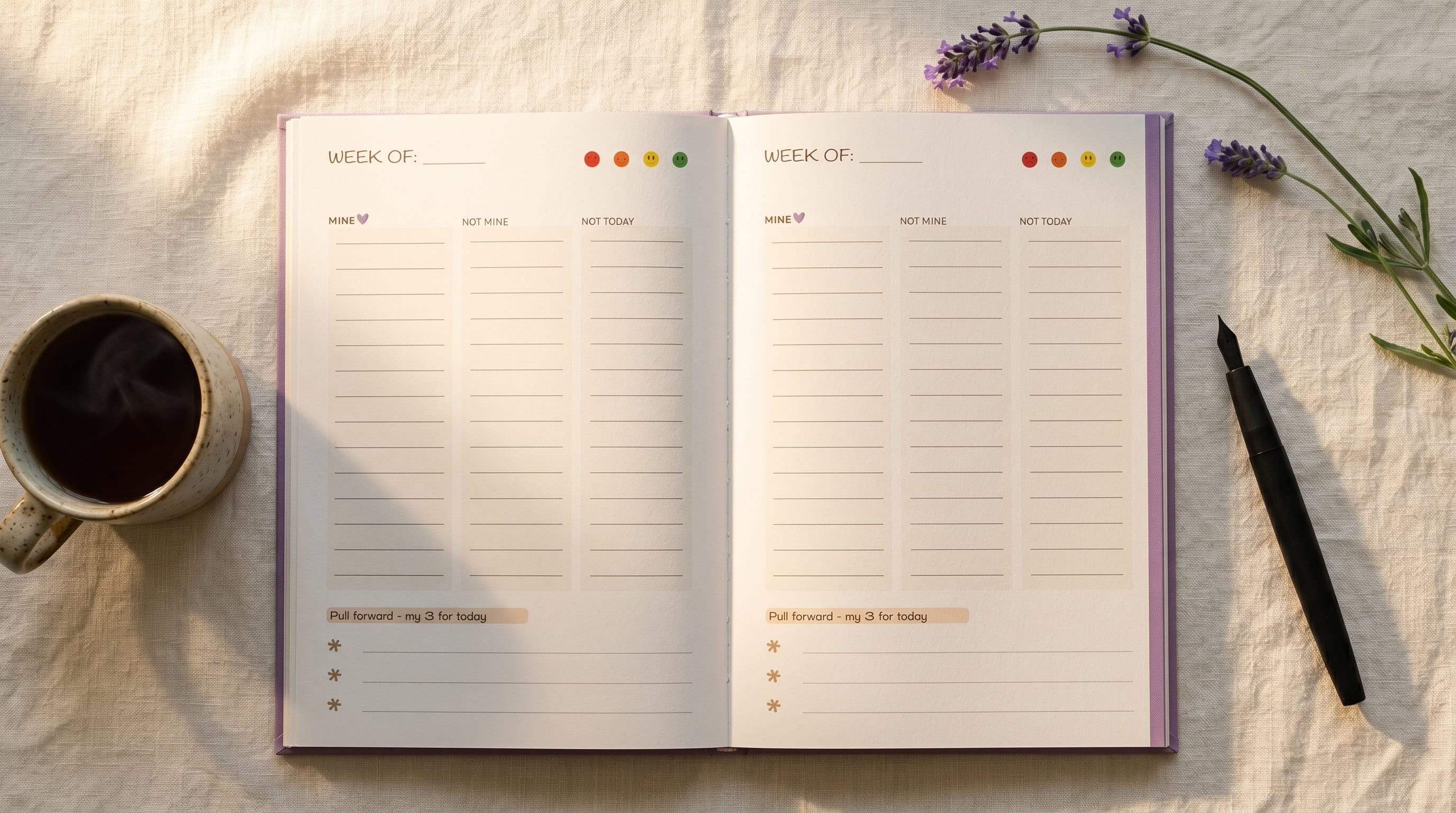
A blank page doesn’t give ADHD brains enough structure. Three columns is the sweet spot: enough shape to be useful, not so much that the sorting becomes a project.
Take one piece of paper. Turn it landscape. Draw two lines down. Label:
Column 1: MINE
Things that are genuinely your responsibility and you want to move on. Your priorities, your projects, your admin, the stuff only you can do.
Column 2: NOT MINE
Things that ended up in your head but actually belong to someone else. A coworker’s worry. Your mum’s logistics. A friend’s indecision you’ve been carrying. An assumption that turned into a task without you agreeing to it.
These don’t get a to-do list entry. They get a decision: send it back, decline, hand it over, or just stop holding it.
Column 3: NOT TODAY
Real things, yours, but not for this week. Future-you’s problem on purpose. This column is how you stop “someday” tasks from sitting on every daily list and silently making you feel behind.
Dump everything from your head into the 3 columns. Set a timer for 10 minutes. Stop when the timer stops.
Only Column 1 ever becomes a to-do list. That’s the rule that makes this work.
How to Actually Use the Dump (5 Steps)
Getting it on paper is the easy part. Most brain dumps die right here. The sheet goes in a drawer, nothing changes, and the head fills right back up.
Here’s the part that makes it stick.
- Dump for 10 minutes. Timer on. Three columns. Don’t edit while you go.
- Review Column 2. Decide, for each one: send it back, decline, or let it go. Text the person, schedule the handoff, or just mentally close the tab. The column ends up empty.
- Skim Column 3. Park it in a “later” list, a future-month page, or just date the sheet and file it. Not today’s problem.
- Pull 3 items from Column 1. Not five. Not ten. Three. These are your actual to-do list for the day.
- Close the book. The brain dump goes away now. The to-do list is the only thing in front of you for the next 2–4 hours.
The whole loop is the point. A brain dump without step 4 is just stress on paper. A to-do list without steps 1–3 is stress with numbers next to it.
When to Brain Dump vs. When to Use a To-Do List
Both tools earn their keep. They earn it on different days.
Brain dump when:
- You can feel “17 tabs open” in your head but can’t name any of them.
- It’s Sunday evening and the week ahead feels unknowable.
- You’re about to fall asleep and your brain starts filing invoices.
- You’ve had a big conversation, a hard week, or a plan change.
- You’ve been “meaning to get organised” for three weeks and keep not starting.
To-do list when:
- You already know the next 3–5 things.
- You’re mid-week, mid-project, and need to execute, not decide.
- You have a deadline in under 48 hours.
- You just finished a brain dump (ideal).
Rough cadence that works for a lot of ADHD brains: brain dump weekly, to-do list daily. Sunday evening dumps tend to steal the least from the rest of the week. If Sunday evening is also when guilt about an “unproductive” weekend creeps in, that’s a separate pattern worth its own look.
5 Mistakes That Turn a Brain Dump Into Another Problem
- Making it pretty. Neat handwriting is a stalling tactic. The dump should look chaotic. If it doesn’t, you’re editing.
- Dumping without deciding. Getting it out of your head only works if you then do something with Column 2 and Column 3. Otherwise your head just re-downloads it.
- Moving everything to the to-do list. If Column 1 has 22 items, you do not have 22 to-dos. You have a list of options to choose 3 from.
- Dumping daily. Daily brain dumps turn into journalling, which turns into avoidance of the actual sort. Weekly is the target.
- Skipping the timer. Without a timer, this becomes a two-hour feelings session. Ten minutes forces the dump to be honest.
What a Brain Dump Is Not
- A journal is open-ended processing; a brain dump has a timer and an exit.
- If Column 2 is full of one person, that’s data. More dumping won’t answer it.
- It feeds the plan without ever being the plan.
- Everything that comes out is allowed, including the pettiness.
The Short Version You Can Actually Remember
- To-do lists assume sorting you haven’t done yet.
- Brain dumps do the sorting, in 3 columns: Mine, Not Mine, Not Today.
- Only Column 1 becomes the list. Pull 3 items. Close the book.
- Brain dump weekly. To-do list daily.
- If your “list” never ends, it’s a dump in disguise.
That’s the whole method.
Want a Planner That Holds the Dump For You?
Drawing three columns on scratch paper works. (A lot.) It also slowly devolves into sticky notes, margin scribbles, and one planner page with an angry rectangle on it.
Our Flowers ADHD Planner has a full-page “Everything on my mind” brain-dump up front for the big purges, a Categorise-When-Ready sorting page to split what’s yours from what isn’t, and a brain-dump box on every monthly spread so the pile never has to wait. No more sticky-note chaos.
Designed in Europe. Made for brains that don’t fit neat boxes.
Pink Lobster Creatives is run by Liesbeth, a surface pattern designer building the tools she wished she’d had 10 years ago. Everything here comes from lived experience rather than a medical qualification. Nothing on this blog is a substitute for advice from your doctor, therapist, or ADHD coach. Strategies that work for one person with ADHD may not work for another. If something resonates, take it. If it doesn’t, leave it.
Related reads:
Leave a Reply