
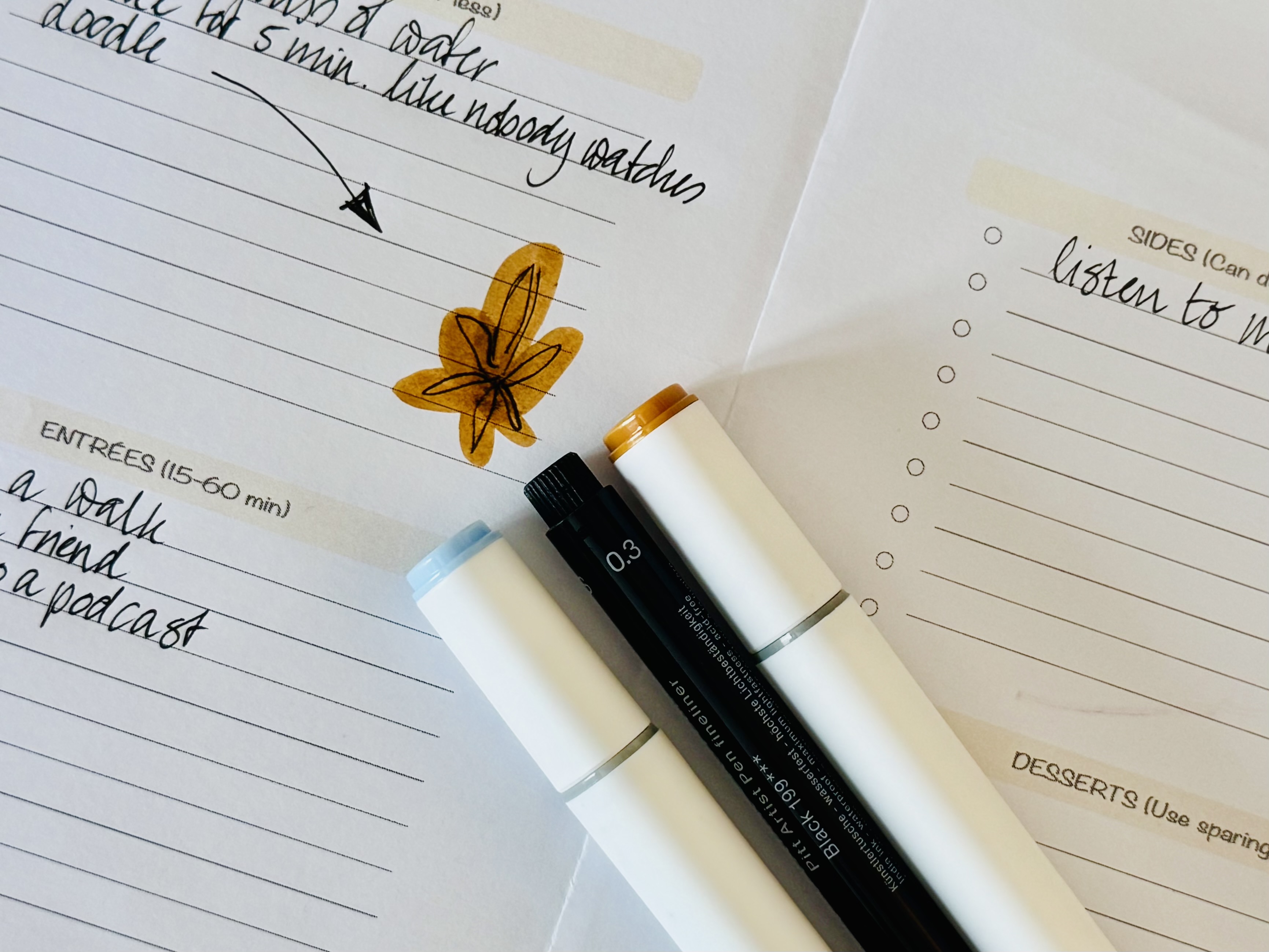
The 20-Second Version
A dopamine menu is a pre-made list of small, healthy activities that give your ADHD brain a dopamine hit — so when you’re stuck, overwhelmed, or spiralling into scroll-mode, you already know what to reach for.
Think of it like a restaurant menu. Instead of ordering food, you’re ordering a mood shift.
That’s it. That’s the tool.
Why Your ADHD Brain Needs One
Here’s something a lot of productivity advice skips: researchers have been writing about dopamine regulation as part of the ADHD picture for years — and most of us with ADHD already know this from lived experience. Your brain isn’t lazy. It isn’t broken. It’s wired differently — and that wiring loves stimulation, whether you choose it consciously or not.
Left to autopilot, the ADHD brain tends to grab the fastest, loudest dopamine source available. That usually looks like:
- Doomscrolling for 47 minutes “just to decompress”
- Opening the fridge when you’re not hungry
- Online shopping you’ll regret at checkout
- Starting a new hobby at 11pm instead of sleeping
- Hyperfocusing on someone else’s problem to avoid your own
None of these are moral failures. They’re default dopamine. Your brain is doing exactly what it was designed to do — seek stimulation — just without a better option on the shelf.
A dopamine menu gives your brain a better option on the shelf.
How to Build Your Own Dopamine Menu (in 10 Minutes)
A dopamine menu works best when it’s split into four categories — like sections on a real menu — based on time and effort.
1. Appetizers (2–5 minutes, zero effort)
Quick hits for when you’re stuck, overwhelmed, or mid-task-paralysis. These are your emergency regulation tools.
Examples:
- Step outside and look at the sky for 60 seconds
- Splash cold water on your face
- Play one song at full volume
- Text a friend a stupid meme
- Stretch your arms above your head for 30 seconds
- Drink a big glass of water
- Pet your animal / a houseplant
2. Entrees (15–60 minute)
Longer, more satisfying resets. Use these when you’ve got a pocket of time but can’t face deep work yet.
Examples:
- Go for a walk without your phone (or with a podcast, no rules)
- Cook one real meal, no multitasking
- Do a single load of laundry, start to finish
- Take a shower and actually change clothes
- Do 20 minutes of a hobby you “don’t have time for anymore”
- Organise one drawer — just one
3. Sides (can do alongside other tasks)
Activities you can do alongside boring tasks to make them more enjoyable.
Examples:
- Doodling or coloring
- Listen to a podcast or audiobook
- Taking a phonecall during a walk
- Setting a visual timer to break up a long task
4. Desserts (indulgent but healthy, 5–15 min)
Small treats your brain wants that don’t leave you worse off afterwards.
Examples:
- A proper coffee or matcha, made slowly
- 10 minutes of your favourite playlist, eyes closed
- A hot bath or a cold shower
- Writing one paragraph in a journal
- Lighting a candle and doing literally nothing
5. Emergency snacks
Ready to eat food that gives you a rapid dopamine boost.
Examples:
- dark chocolate
- Greek yoghurt with berries / granola
- hard boiled egg
- fruit
Aim for 5–7 items per category. More than that and your menu becomes another decision. Less than that and you’ll run out of novelty, which is the one thing your ADHD brain can’t forgive.
5 Rules That Make a Dopamine Menu Actually Stick
Most dopamine menus fail for the same reasons. Here’s how to avoid them.
- Write it down somewhere visible. A Note on your phone buried between grocery lists will not save you. Put it on your fridge, your desk, or in your planner.
- No “shoulds” on the menu. If flossing isn’t something your brain genuinely enjoys, it doesn’t belong here. This is a dopamine menu, not a shame list.
- Refresh it every 4–6 weeks. ADHD brains chase novelty. A menu that stops being novel stops working. Swap out a third of it each month.
- Test in low-stakes moments first. Don’t wait until you’re in a full shutdown to try using it. Practice the menu on a mildly boring Tuesday so your brain knows where it is.
- Track what actually works. Star the items that consistently pull you out of a slump. Delete the ones that sounded nice but never get touched.
When to Use Your Dopamine Menu
Pull out your menu when you notice any of these:
- You’ve been on your phone for 20+ minutes with nothing to show for it
- You opened a tab, forgot why, and opened three more
- You’re in front of a task and your brain feels staticky
- You’ve said “I’ll just rest for a second” twice in an hour
- You feel the beginning of a shame spiral about productivity
These are all signals that your brain is asking for dopamine. The menu is how you answer the question on purpose instead of by accident.
What a Dopamine Menu Is Not
Before anyone DMs me: a dopamine menu is not a replacement for medication, therapy, or a proper ADHD treatment plan. It’s a tool. One of many.
It also isn’t:
- A to-do list in disguise
- A productivity hack to “earn” rest
- A list of things you should enjoy
- A reason to feel guilty if it doesn’t work on the first try
If your menu starts feeling like homework, strip it back. The whole point is that the menu is easier than scrolling. If it isn’t, it’s the wrong menu.
The Short Version You Can Actually Remember
- ADHD brains tend to seek stimulation more intensely than neurotypical brains.
- Without a menu, we grab whatever’s fastest (usually the phone).
- With a menu, we have a pre-decided list of healthier hits.
- Four categories: Appetizers, Mains, Desserts, Specials.
- 5–7 items each. Refresh monthly. Keep it visible.
That’s the whole tool.
Want a Dopamine Menu Built for You?
Building a menu from scratch is the kind of task that sounds simple and then sits unfinished on your desk for three weeks. (We see you.)
Our Flowers ADHD Planner includes a ready-to-use dopamine menu page — pre-categorised and designed to actually get used instead of filed away. Fill in your own examples or use ours as a starting point. Either way, you skip the hardest part: the staring-at-a-blank-page part.
→ Get the Flowers ADHD Planner
Designed in Europe. Made for brains that don’t fit neat boxes.
Pink Lobster Creatives is run by Lies — a surface pattern designer building the tools she wishes she’d had 10 years ago. Everything here comes from lived experience, not a medical qualification. Nothing on this blog is a substitute for advice from your doctor, therapist, or ADHD coach. If something resonates — take it. If it doesn’t — leave it.
Leave a Reply