
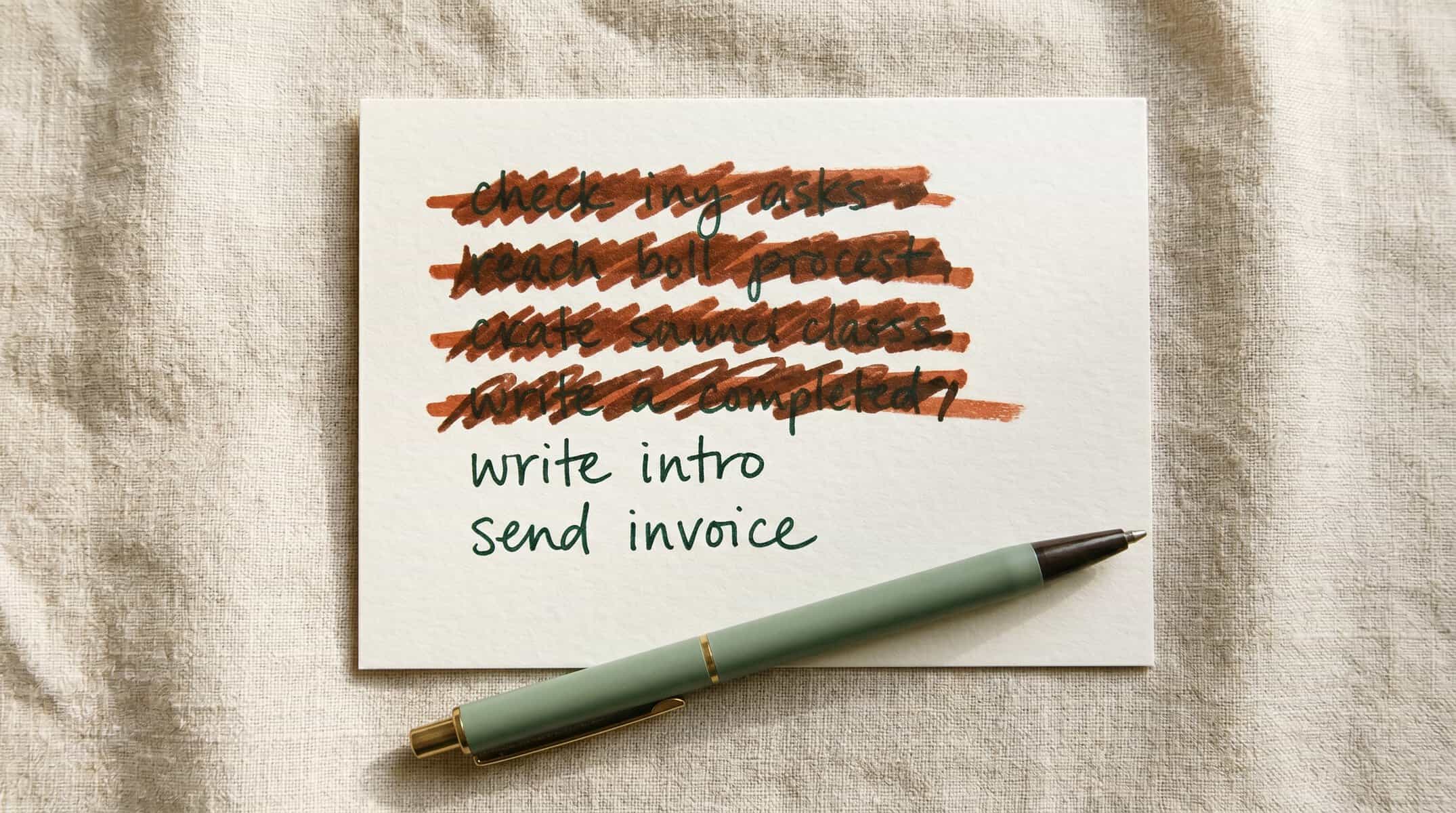
Every productivity system you’ve tried has asked you to add something. A new tracker. A better habit loop. A more detailed weekly review. For many ADHD brains, this is exactly backwards.
More structure doesn’t help a brain that’s already overwhelmed by structure. More tasks on the list don’t help a brain that’s paralysed by the five that are already there. More systems don’t help when the problem is the weight of too many things demanding attention at once, not the absence of a system. The Subtract Method starts from a different premise: you’re not doing too little. You’re holding too much.
Some links in this post are affiliate links. If you buy through them I get a small commission, at no extra cost to you. I only link to tools or books I actually use or have used. The planner is mine, that’s the main thing this site exists for.
What “Holding Too Much” Actually Looks Like
Not the dramatic version. The everyday one.
- Opening your planner and immediately feeling behind before you’ve written a single thing
- A to-do list so long you can’t decide where to start, so you don’t start anything
- Writing out every task you can think of, then closing the notebook without touching any of them
- Spending more energy managing the list than doing what’s on it
- Adding a new task the moment you complete one, so the list never actually gets shorter
This is what happens when a planning system is designed to capture everything and prioritise nothing. For neurotypical brains, a long list is manageable because the brain can scan it, assess urgency, and move. For ADHD brains, a long list is often a wall. The brain sees the mountain, not the first step, and stops before it starts.
Why Standard Prioritisation Doesn’t Help
The usual fix is to prioritise: rank your tasks, put the most important ones first, do those. In theory, this should reduce the load. In practice, for many ADHD brains, it adds another layer of work on top of work that hasn’t started yet.
Prioritising requires holding the whole list in view while simultaneously evaluating each item against the others. It’s a cognitive task that consumes the same resource you needed for actually doing things. By the time the list is sorted, the capacity to act on it is gone.
And the list still has twenty items on it. You’ve just arranged them differently.
What the Subtract Method Actually Does
The Subtract Method works in two steps, and the second one is the one that matters.
Step one: Capture first, sort later. Brain dump everything out of your head and onto paper. Every task, every worry, every vague “I should probably…”. Get it out. Don’t sort it while you’re capturing it. The job here is just to empty the working memory so it has space to function. A brain dump page that holds everything is not a to-do list. It’s an offload.
Step two: Halve the list. Then halve it again. Take what you’ve captured and ask: what actually has to happen this week? Not what you’d like to get done. Not what would be impressive. What has to move. Cut to that. Then from that shorter list, ask the same question again. What has to happen today? Cut to that. Five tasks, not twenty-five. Three anchors, not a colour-coded schedule. The constraint is the method.
This is not about low ambition. It’s about giving the tasks that matter enough space to actually happen, instead of letting them disappear into the noise of forty things that all feel equally urgent.
The One Rule That Makes It Work
Never capture and sort at the same time. This is the rule that makes everything else possible.
When you try to decide whether something goes on the list while you’re trying to remember everything else that also belongs there, you’re running two cognitive tasks simultaneously. The capturing suffers because you’re evaluating. The evaluating suffers because you’re still capturing. Both suffer because the working memory is stretched across both at once.
Separate them. Empty first. Then decide what stays. The brain dump page holds everything. The to-do block holds five things. They’re not the same page, and they’re not used at the same moment. That gap, between capture and sort, is where the Subtract Method actually lives.
Short Version
- Standard planning adds more. The Subtract Method removes what doesn’t need to be there
- Many people with ADHD describe feeling overwhelmed by long task lists, not motivated by them
- Capture first: brain dump everything without sorting it
- Then halve the list, twice, until only what must happen remains
- Never capture and sort at the same time: the gap between them is the method
- Five intentional tasks beat twenty aspirational ones, every time
Two books that name the same principle
The Subtract Method is not a new idea. It’s a name for what these two books quietly demonstrate.
Tiny Habits by BJ Fogg. Smaller than you think. Then smaller again. The opposite of “set audacious goals.”
Getting Things Done by David Allen. Capture first, sort later. The principle behind the planner’s Categorise When Ready page.
→ Getting Things Done on Amazon
Built Into the Planner, Not Bolted On
Most planners give you one page for everything: a single space where you’re expected to capture, sort, schedule, and prioritise all at once. The Flowers ADHD Planner separates the functions by design. The Brain Dump pages on every monthly spread hold the full offload, so nothing gets lost, and nothing has to be processed until you’re ready. The weekly To-Do block holds five lines, not twenty-five, which forces the halving to happen before the week starts. And the Categorise When Ready page, built into the Brain Dump spread, means the sorting step is available when the brain has space for it, not when the capture is happening.
Designed in Europe. Made for brains that don’t fit neat boxes.
This content is for educational and informational purposes only. Pink Lobster Creatives is run by Lies, a surface pattern designer building the tools she wished she’d had 10 years ago. Everything here comes from lived experience, not a medical qualification. Nothing on this blog is a substitute for advice from your doctor, therapist, or ADHD coach. If something resonates, take it. If it doesn’t, leave it.
Leave a Reply