
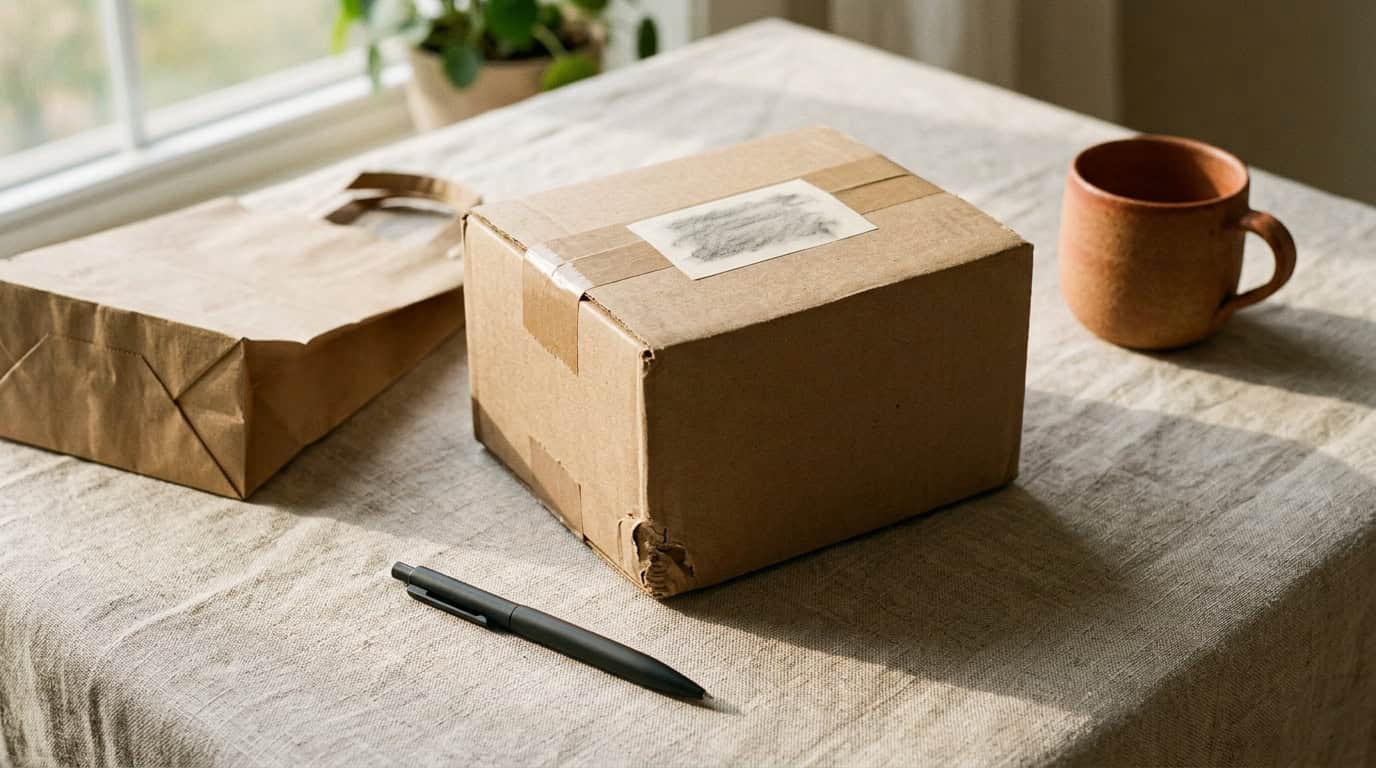
There are four bags in my hallway right now. Three are for the charity shop and one is bin. They have been there since Sunday, which means the decluttering worked and the declutter did not, and the difference between those two things is most of what this post is about.
Nearly all decluttering advice assumes the hard part is deciding. Pick it up, hold it, ask yourself whether you want it, put it in the right pile. For many people with ADHD, deciding is manageable in short bursts. What becomes harder is what happens when every decision creates another task: the deciding produces four new piles, and piles are exactly what you started with, except now they are in the middle of the floor and the room is worse than it was at ten o’clock.
So this is an ADHD decluttering method built the other way round: five piles, three questions, and one rule about the door. Twenty minutes, no weekend, no before-and-after photos.
Why Most ADHD Decluttering Methods Stall Halfway
Three separate things happen in a normal decluttering session, and most methods treat them as one job.
There is sorting, which is fast. There is deciding, which is slow and gets slower as the session goes on. And there is removal, which is boring, involves the car, and almost never happens on the same day.
The middle one is where mine tends to stall. You pick up something with a decision attached to it (the dress that fitted in 2019, the cable that goes to something, the card from someone who died) and the session stops. Not for a minute. It stops entirely, because that object is not clutter, it is a decision you have not made yet, and a decision does not move with a timer.
Then the energy is gone, the floor is covered, and the room has to be put back the way it was so you can walk through it.
The Five Piles
Five, not four. The fifth is the one that does the actual work.
- Back where it lives. Right now, this trip, before anything else. It is not clutter, it is just somewhere else.
- Bin. No decision required. If you have to think about it, it goes in pile 5.
- Donate. One bag. When the bag is full, the bag is closed, and closing it is allowed to be the end of the session.
- Not mine to decide. Other people’s things, shared things, anything with a second opinion attached. Into a box with their name on it, out of your hands.
- The maybe box, with a date written on the lid.
Pile 5 is the reason the other four ever leave the room. The maybe box isn’t where things go to live forever. It’s where a decision goes when making it today would stop the whole session.
So it gets a date. Mine is three months out, written on the lid. If I haven’t opened the box by then, I treat that as a strong enough signal to let the contents go, and the box goes to the charity shop unopened. Unopened is the part that matters. Opening it is just the same twenty decisions again, with worse lighting.
I have done this four times now. Twice I went into the box for one specific thing. Neither time did I want anything else that was in there.
The Exit Rule
A declutter is not finished when the sorting is finished. It is finished when the piles are out of the room, and the ADHD version of that has to happen in the same session or it does not happen at all.
So the rule is: nothing gets sorted that cannot leave tonight. Bin bag out to the bin. Donate bag in the boot of the car, not by the front door, where it will become part of the scenery within a week. Maybe box on a shelf with its date on it. Other people’s box handed over or put in their room.
That is what limits the size of the session, and it is supposed to. If you only have twenty minutes and the last five of those are the exit, then the sorting gets fifteen minutes, and fifteen minutes of sorting is enough to produce a real, finite result. Sometimes that’s one bag. Sometimes it’s one drawer. Either way it is finished. Four bags in a hallway is a project that is still open.
The hallway bags I mentioned at the top are a failure of this rule, not of the method. I sorted on a Sunday when the car was not there.
Three Questions That Aren’t “Does It Spark Joy”
Joy is a bad test at nine in the evening, at least for me. It asks me to consult a feeling that isn’t available, about an object I’m already tired of looking at. These three are answerable when you have nothing left.
- Do I already have another one of these? Duplicates are the cheapest decisions in the room and there are always more of them than you think. Start here, because the first five minutes set whether the session keeps going.
- If it disappeared tonight, would I buy it again this month?
- What is it costing me to keep? Not money. A surface, a shelf, a drawer that has to be dug through every time, the two seconds of low-level noise every time you see it.
Question 2 is the one that settles the objects the other two cannot. It moves the question out of the past, which is where the guilt is, and into a week you can actually picture. Most things fail it instantly and it is not a close call. The few that pass it, you keep without arguing, which is the other half of why it works.
Where to Start, When Every Room Qualifies
Not the room that bothers you most. That room is usually the one with the most decisions in it, and you will spend your fifteen minutes on three objects.
Start with a container you pass through every day: the kitchen table, the chair, the shelf by the door, the bag you have been carrying around for a week. Somewhere with high traffic and low emotional weight. The point of the first session is not the square metres, it is finding out that a session can end.
If the whole thing feels immovable before you begin, that is a load problem rather than a motivation problem, and the fix is to make the container smaller, not to find more willingness. And if you cannot start at all, the three moves that unstick a freeze come before any of this.
When the Pile Is a Decision, Not a Mess
Some piles have been in the same spot for months. Paperwork that needs a phone call. The box from a house you moved out of. Something that belonged to someone.
Those are not decluttering. They are tasks wearing a mess costume, and a timer will not shift them, because the work in them is not lifting and sorting. Take them out of the declutter entirely and put the actual task on a list where it can be looked at on a day with capacity. The room gets easier when you stop treating an unresolved task as a decluttering failure. And if that describes most of the pile rather than a couple of objects in it, you are looking at a different job to this one: what an ADHD doom pile is actually made of splits it into three, and only one of the three keeps coming back.
The ADHD Decluttering Method in Short
Five piles: back where it lives, bin, donate, not mine to decide, and the maybe box with a date on the lid. Three questions: do I have another one, would I buy it again this month, what is it costing me to keep. One exit rule: nothing gets sorted that cannot leave the room tonight.
Fifteen minutes of sorting, five minutes of exit, one finite result. Then you stop, and the room is better than it was, which is the whole trick. A method you can do again on Thursday beats a weekend you will not be having.
A Planner With Somewhere to Put the Date
The box has the date. What the box cannot do is make sure the date exists somewhere you will actually see it, because a lid in a cupboard is not somewhere you look. That part has to land where you already are.
The Flowers ADHD Planner has an undated monthly overview for exactly this kind of thing: something three months out that needs one line and no follow-up until then. The five-line weekly to-do is where the declutter session itself goes, at one line, on the day you have the car.
Undated. Designed in Europe. Made for brains that don’t fit neat boxes.
Pink Lobster Creatives is run by Liesbeth, a surface pattern designer building the tools she wished she’d had 10 years ago. Everything here comes from lived experience rather than a medical qualification. Nothing on this blog is a substitute for advice from your doctor, therapist, or ADHD coach. Strategies that work for one person with ADHD may not work for another. If something resonates, take it. If it doesn’t, leave it.
Leave a Reply