
I am, at the same time, the person who forgot to eat lunch and the only person in this house who remembers the dentist appointment. Nobody warns you about that contradiction going in. Your own brain drops your own name mid-sentence, but somehow you are the family’s human calendar for six other people’s obligations. Today: why the ADHD mental load stopped being just exhausting for me, and started being something I could actually use.
The 20-Second Version
The ADHD mental load is exhausting for a reason that has nothing to do with your memory: none of it lives anywhere anyone else can see. A better memory would not help. Putting it on paper, where the whole house can look at it, does.
What It Actually Looks Like
You know the library books are due Thursday for a kid who is not yours. You forgot you had a call at two. You are the emergency contact for three people who have never once returned the favor. Your brain holds everyone’s shoe size and nobody’s birthday, including your own, without a single notification going off.
You remember which cousin is allergic to what, three years after that dinner. You do not remember why you walked into the kitchen. Somehow, the spare keys for a house you visited once in 2022 are still filed away in your memory, shelf and all. Your own passport number could be sitting in the freezer for all you’d know.
Someone asks, did you remember to book it. The answer is always yes. Nobody asks how. Apparently the calendar just updates itself.
Nobody asks how because the how is invisible by design. There is no meeting where you present the list. There is no moment where anyone watches you hold six things at once. It only becomes visible the one time you drop something, and that is the version of you people remember. The four hundred things that did not fall through never made it into anyone’s story about you.
Why “Just Remember Less” Doesn’t Work
A lot of advice says stop caring so much. Hand it off. Let go. That advice assumes the problem is that you are holding on too tightly, that you could simply choose to stop tracking things if you tried a little harder. This is the same trap as being told to just relax when you’re overwhelmed. It treats a structural problem like a mindset problem.
Here is what actually happened. Your brain drops its own stuff constantly, so at some point you built an external system just to survive your own week. A notebook, a note in your phone, a planner that lives on the counter. Once that system existed, it was the only working tracking system in the entire house. Everyone’s stuff moved in, not because you invited it, but because it was the only place that reliably held anything.
Remembering was never where you fell short. You’re carrying more of it than one brain was ever built to hold, and somewhere in there you built the only functioning piece of infrastructure in the building. Now you’re running unpaid IT support for six people who do not know the system exists, because it lives in your head or in a notebook only you open.
Call it what it is: infrastructure. Nobody has thanked you for it yet, mostly because nobody knows it is there.
This is where the reframe actually pays off. The same brain that cannot hold its own passport number turned out to be excellent at building a system, because it had to. Most people never build one, because their memory never forced them to. Yours did. That is the part standard advice skips completely.
Make the ADHD Mental Load Visible
The fastest change has nothing to do with doing less. Move what you already track out of your head and onto something other people can actually see. A shared list on the fridge. A calendar block with everyone’s name on it. A page in a planner you leave open on the counter, the same way a weekly reset keeps the rest of your system honest.
This will not make anyone else pick things up on day one. Most people will not, at first, and that is genuinely fine. Instant help was never the goal. The load stops being invisible, including to you, and that is what changes things. It is much harder to keep treating something as “no big deal” once it is written down in a list that visibly takes up half a page.
There is a particular kind of relief in watching someone else finally see the list. They rarely grab a marker and start dividing tasks. Usually they just go quiet for a second. That quiet is the whole point.
Write It Once, in One Place
The moment someone says “don’t forget the form,” write it down immediately, in the same place every single time. Skip the “I’ll remember.” You will remember, that is the whole problem. You remember everything, and it all lands in the same overloaded folder in your head, filed under nothing.
One capture point. It does not matter if it is the notes app, a sticky note on the fridge, or the brain dump page in a planner (more on that below). What matters is that it is always the same page, so your brain stops running a live index of forty scattered locations just to answer “did we already order the birthday present.”
The Redistribution Ask, Without the Whole Production
You do not need a sit-down conversation with slides to hand off one recurring task. Pick the smallest, most repeatable thing on your list, the library books, the recycling schedule, watering the plant that has survived worse, and hand off that one specific thing with a specific ask: “This is yours now. I’ll remind you twice, then it’s on you.”
Twice, and then you’re done reminding. You are allowed to stop being the safety net for a task you already handed over out loud. If it slips the third time, that is now a different person’s problem, and you are allowed to let it stay theirs.
Start with the task you resent the most. Size has nothing to do with it. Resentment is a better compass than importance here. The recycling schedule you silently see about every single week does more damage to you than the one big annual thing everyone remembers anyway.
When Nobody Picks It Up
Sometimes you make the list visible, hand off the one task, say the sentence out loud, and it still all drifts back to you within a week. That happens. The visible list still did its job. This particular household just needed more than one round of it, and that is worth naming instead of absorbing silently and trying again from scratch alone.
Want a Place to Put All of It?
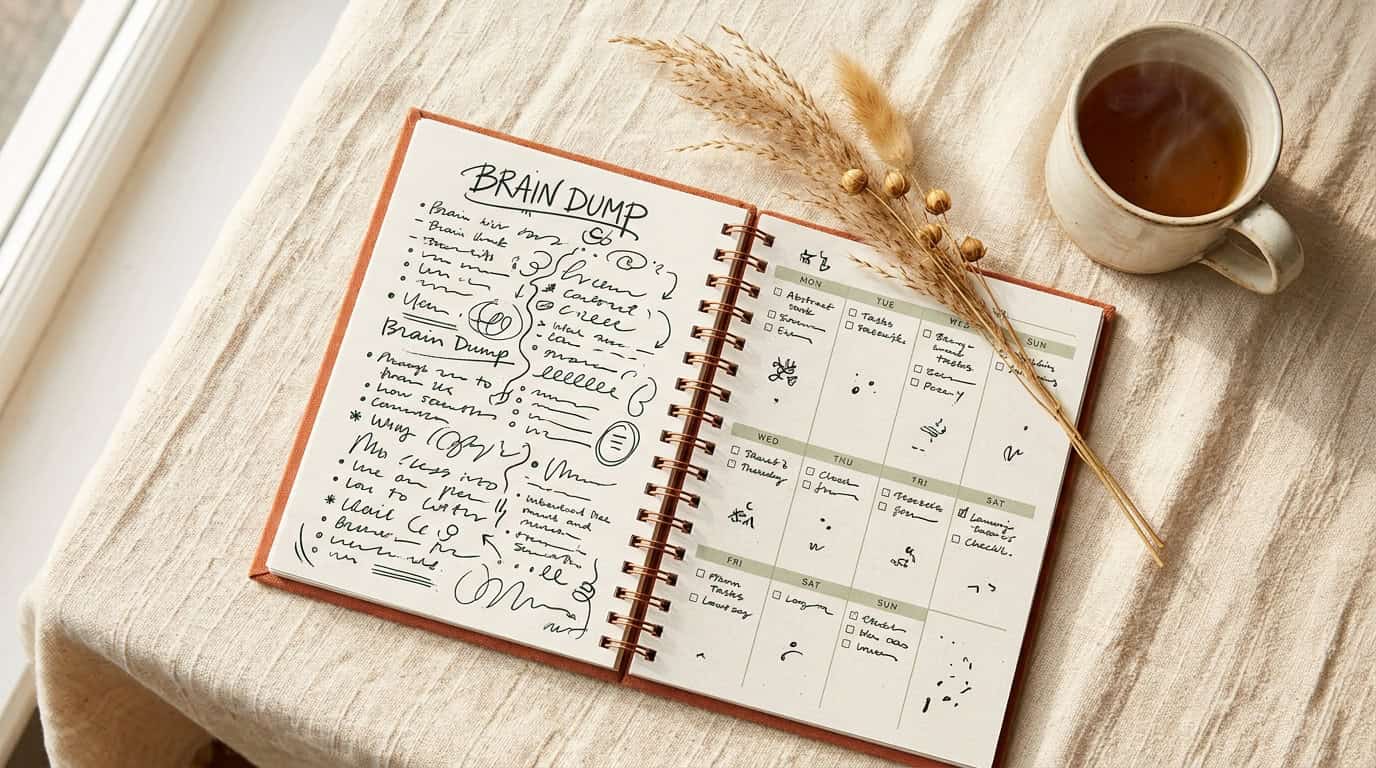
The Flowers ADHD Planner has a brain dump spread built for exactly this. It is a place to unload the running list in your head before it turns into a 2am worry session, which is a different job from a to-do list. Pair it with the weekly spread and the undated pages, and the invisible stuff finally has somewhere to live besides your head.
The planner’s real job is making that infrastructure visible, the same one you already built in your head, just finally out where the rest of the house can see it.
Designed in Europe. Made for brains that don’t fit neat boxes.
→ Get the Flowers ADHD Planner
Pink Lobster Creatives is run by Liesbeth, a surface pattern designer building the tools she wished she’d had 10 years ago. Everything here comes from lived experience rather than a medical qualification. Nothing on this blog is a substitute for advice from your doctor, therapist, or ADHD coach. Strategies that work for one person with ADHD may not work for another. If something resonates, take it. If it doesn’t, leave it.
Related reads:
Leave a Reply