
It’s 5:30pm on a Wednesday. You are standing in front of the open fridge. The fridge contains: half an onion, three eggs, a jar of pickles, and a feeling. You have been “thinking about dinner” since approximately 11am and have deferred the actual decision four times.
You consider toast. You had toast yesterday. You consider eggs again. You had eggs three times this week. You close the fridge. You open the fridge. You close the fridge. You consider ordering food and feel the small specific guilt of someone who has plenty of food in the house.
This is not a cooking problem, even though it looks like one. It’s a decision-fatigue problem dressed up as a kitchen problem — and standard ADHD meal planning advice makes it worse, not better. The fix is not a Sunday meal-prep marathon. The fix is removing the 5:30pm decision from the system entirely.
The short version
ADHD meal planning fails because every night needs a fresh decision when the brain is most depleted. Build a default dinner menu of five meals you actually like, decide in the morning which one is happening, keep the ingredients visible, and have one zero-effort backup for the no-spoons nights. No batch cooking. No prep containers. Five minutes a week.
Why Sunday meal planning rarely works for ADHD brains
Most meal planning advice assumes a brain that holds Sunday’s intention through Wednesday. Sunday-you decides that Tuesday is roasted vegetables and quinoa. Tuesday-you wants ramen.
This isn’t a willpower failure. It’s a shape mismatch. Sunday-you and Tuesday-you have different bodies, different energy levels, different sensory tolerances, and often different cravings entirely. The meal plan that felt inspired on Sunday afternoon often feels punishing by Wednesday — and once one night goes off-plan, the whole structure tends to collapse.
Many ADHD brains find this pattern especially pronounced. Energy varies day to day, sensory tolerances shift, and the brain that wakes up on Tuesday genuinely has no obligation to honour the food choices Sunday-brain made on its behalf.
Standard meal prep makes it worse. It adds 2–3 hours of executive function to a Sunday already crowded with other resets, then locks you into specific meals you may not want by mid-week. The containers in the fridge become small accusations. By Thursday you are eating cereal and feeling guilty about the containers.
The point isn’t that meal planning is wrong. The point is that this kind of meal planning was probably built for a brain that runs differently than yours does.
The dopamine menu, applied to dinner
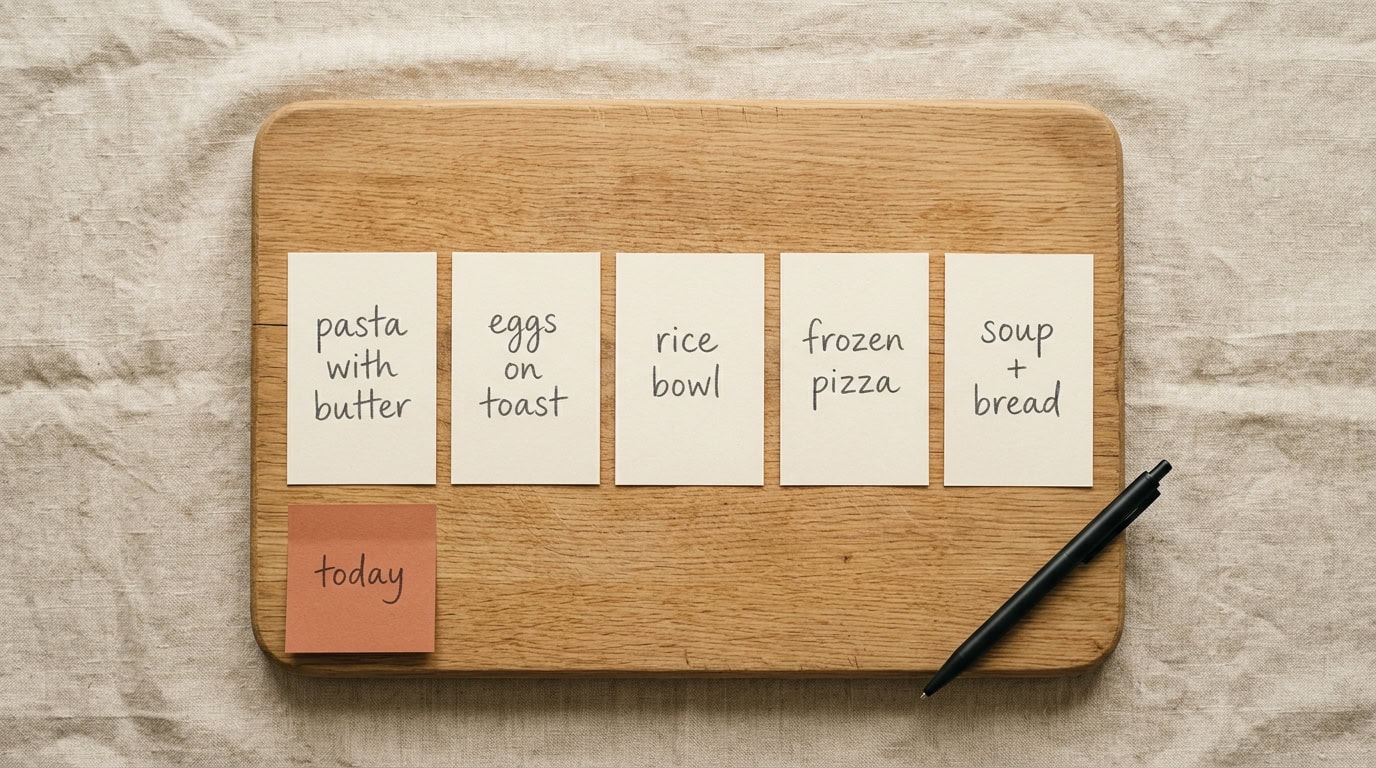
A dopamine menu is a pre-decided list of activities that are ready when the brain isn’t. The same logic, applied to food, looks like this: instead of meal-planning every Tuesday from scratch, you keep five default dinners on rotation, decide in the morning which one is happening, and remove the 5:30pm decision entirely.
The default menu isn’t a meal plan. It’s a choice pool. You don’t decide that Monday is curry. You decide that the menu contains curry, and Monday-you (in the morning, not at 5:30pm) picks from the menu. The decision happens once a week to build the menu, and once a day to pick — both times when executive function actually exists.
Decisions made on a tired brain at 5:30pm cost five times what the same decisions cost at 9am over coffee. Moving the choice to the morning is the entire shift.
The five rules of ADHD meal planning (without prep)
These are the rules that hold the system up. The first one removes most of the problem.
1. Five defaults — on rotation, not on schedule
Pick five dinners you genuinely like, can make on a low-spoons day, and would happily eat once a week. That’s it. Write them down somewhere visible.
The five are a menu, not a schedule. You can have the same dinner two nights in a row. You can skip one for two weeks. Many people find that having the list visible — even if you don’t follow it every day — reduces the 5:30pm spiral on its own, because the brain has something to land on instead of “let me think.”
2. Decide in the morning, not at 5:30pm
This is the most important rule. The brain at 9am, with coffee, has executive function. The brain at 5:30pm, after eight hours of work, does not. Making the choice at 9am takes 30 seconds. Making the same choice at 5:30pm takes 25 minutes of opening and closing the fridge.
Anchor this to something you already do. Many people find that anchoring it to coffee or to checking the planner works — the same principle as BJ Fogg’s Tiny Habits work on attaching new behaviours to existing routines.
3. Ingredients visible, not just present
A meal that requires opening three drawers and rummaging behind the milk does not happen on a tired day. A meal whose ingredients are at eye-level in the fridge, in the basket on the counter, or in the front of the cupboard does.
This is friction engineering. Move the dinner-relevant ingredients to where you can see them. Move the snacks you keep eating instead of dinner to where you have to look for them. The brain takes the visible path. Use that.
4. One zero-effort backup
The fifth slot on the menu isn’t a meal. It’s a backup. Frozen pizza. Cereal. A bowl of pasta with butter and salt. Whatever requires zero decisions and minimum effort and is okay to eat.
This rule is the permission slip. Without it, the meal plan collapses the first night someone is genuinely depleted. With it, the backup is part of the plan — not a failure of the plan. Many ADHD weeks need the backup more than the menu intends. That’s not a problem; that’s the backup doing its job.
5. No “should” foods on the list
If a meal is on the menu because it’s healthy or because Sunday-you thinks Tuesday-you should want it, take it off. The menu only works if every item is something you would happily eat tonight.
The brain reads through aspirational meal choices. Many people find that one or two “I should eat this” items on the menu drag down the entire system — they get picked last, then never, and the menu starts feeling like a chore. Strip them. Replace with things you actually like.
What this isn’t
A few things worth naming so they don’t sneak in.
It isn’t meal prep in disguise. There’s no Sunday batch cooking. No containers. No 90-minute prep window. The system runs at the speed of choosing from a list.
It isn’t a diet. The menu doesn’t care what’s on it. If the five defaults are pasta with cheese, pasta with vegetables, pasta with sauce, eggs on toast, and frozen pizza — that’s a working menu.
It isn’t a permanent commitment. The five defaults can change every week. They can change every day if you want. The structure is the rotation, not the specific meals.
It isn’t a substitute for cooking when you actually want to cook. Some nights you’ll want to make something elaborate from scratch. The menu doesn’t forbid that. The menu just makes sure the elaborate cooking is a choice you’re making with energy, not a fallback you’re collapsing into out of nowhere.
When the menu isn’t enough
If you’re running on too little sleep or recovering from a hard week, even the backup might feel like too much. That’s a rest situation, not a meal-planning situation. Order something. Eat cereal at 8pm. The menu will be there tomorrow.
If decision fatigue is showing up across more than just dinner — if every decision feels heavy by mid-week — the meal planning fix won’t solve the underlying problem. It will help, but it’s one piece of a wider conversation about where else the decisions live.
And if the freeze is keeping you out of the kitchen entirely, that’s not a menu problem either. The 90-second reset is often the move that gets you in front of the fridge in the first place.
How the planner holds dinner
The Flowers ADHD Planner has the dopamine menu structure built into pages 8 and 9 — five categories ready to fill. Write your five default dinners there. The Energy Check at the start of the week tells you whether this is a week the menu will mostly hold or a backup-heavy week. The Notes box on the weekly spread is where the morning’s choice gets written down so 5:30pm-you finds an answer waiting.
Undated. Designed in Europe. Made for brains where dinner is the wrong place to spend executive function.
Pink Lobster Creatives is run by Liesbeth, a surface pattern designer building the tools she wished she’d had 10 years ago. Everything here comes from lived experience rather than a medical qualification. Nothing on this blog is a substitute for advice from your doctor, therapist, or ADHD coach. Strategies that work for one person with ADHD may not work for another. If something resonates, take it. If it doesn’t, leave it.
Related reads:
What Is a Dopamine Menu? (For ADHD Brains)
5 Dopamine Menu Categories That Actually Work for ADHD
Dopamine Menu Ideas — A Starter List
ADHD Decision Fatigue — Why It Feels Worse Some Days


Leave a Reply