
The reason most ADHD planners fail isn’t the system — it’s that they skip ADHD energy management entirely.
The reason most ADHD planners fail isn’t the system — it’s that they skip ADHD energy management entirely.
The ADHD energy check is one way to work with this more realistically. It takes about two minutes at the start of the week, and it changes what your plan actually looks like.
What planning without an energy check actually looks like
You’ve probably done this one. Sunday or Monday — you sit down, you plan the week. The list has everything that needs to happen. Maybe you even feel reasonably good about it.
By Wednesday, the list looks nothing like what’s been done. Not because you were lazy. Because Monday you were running on five hours of sleep, Tuesday you had that meeting that takes everything out of you, and Wednesday started with a migraine.
None of that was in the plan.
Standard planners ask what you need to do. They don’t ask what you have to give. For many people with ADHD, those are two very different questions — and the answer to the second one can shift a lot from week to week. Planning the same 12-task list every Monday means you’re planning for a version of yourself that only sometimes shows up. When the actual you turns up — tired, slower, running on less — the plan doesn’t fit, and the whole thing collapses.
Why “just be more consistent” doesn’t help here
The standard advice is to build a consistent routine and show up the same way every day. That works if your energy is fairly predictable. For a lot of people with ADHD, it isn’t.
Hyperfocus one week, brain fog the next. A sleep disruption that cascades into three bad days. A run of back-to-back social stuff that leaves you needing a full day of quiet to recover. These fluctuations aren’t a discipline problem — they can reflect changing capacity from stress, overstimulation, poor sleep, or just being human.
Planning the same plan every week means you’re optimizing for your best week. When an average or hard week shows up (which is most of the time), the plan doesn’t fit. And the gap between what you planned and what happened? That’s where the shame lives.
What actually helps is planning to match your current capacity — not some idealized version of it. The energy check is the step that makes that possible.
The 3-tier ADHD energy management system
It’s a quick calibration before you plan the week. Three categories — that’s it.
High-energy week. You’ve slept reasonably well, your schedule is manageable, you feel like yourself. This is the week to tackle the bigger things, have the hard conversations, do the creative work that takes concentration.
Medium week. You’re functional but not running at full capacity. This is most weeks, honestly. Plan for steady and realistic. Get the non-negotiables done and don’t overload the list.
Recovery week. You’re depleted. You’re coming off something hard — a stressful period, bad sleep, an illness, an emotionally heavy few days. This week, the only job is to not fall further behind. Protect yourself, do the minimum, and don’t plan anything that requires your best.
No scoring system. No mood tracking app. No questionnaire. Just: which of these three is true right now?
The answer shapes everything that comes after — how long the task list is, whether you put anything difficult on the schedule, how much buffer you give yourself between things.
How to actually use it
At the start of the week — Monday morning or Sunday night, whichever you use for planning — check in before you touch the task list.
The question isn’t “what do I want to accomplish this week?” It’s “what week is this actually going to be?”
If it’s high-energy: plan more. Take on the thing you’ve been putting off. This is the window.
If it’s medium: pick three non-negotiables and treat everything else as optional. If it happens, great. If not, it moves to next week.
If it’s a recovery week: write down only what absolutely cannot wait. Then write one small thing that will make you feel fractionally less behind. That’s the whole plan.
The trap with recovery weeks is planning them the same way you plan a high-energy week — and then feeling like you failed when it doesn’t happen. The recovery week isn’t a failure. It’s an accurate read of what’s available right now. The plan that works in a recovery week is a short one.
One more thing: the energy check doesn’t fix the week. It just stops you from fighting it. There’s a difference between a hard week and a hard week where you also feel guilty for not doing more. The check at least takes care of the second part.
Short Version
- Most planners assume the same energy every week. Many people with ADHD find their capacity fluctuates a lot more than that.
- The energy check is a two-minute calibration before you plan — not after.
- Three categories: high-energy, medium, recovery.
- Each category changes what actually goes on the list.
- Recovery weeks aren’t failures. They’re an honest read of what’s available.
- It doesn’t fix the week. It stops you from fighting it — and from adding shame on top.
If you want this built in
Most planners don’t have space for this. Same number of lines every week, same layout regardless of what kind of week you’re having. The gap between what you planned and what actually happened is just evidence that sits there.
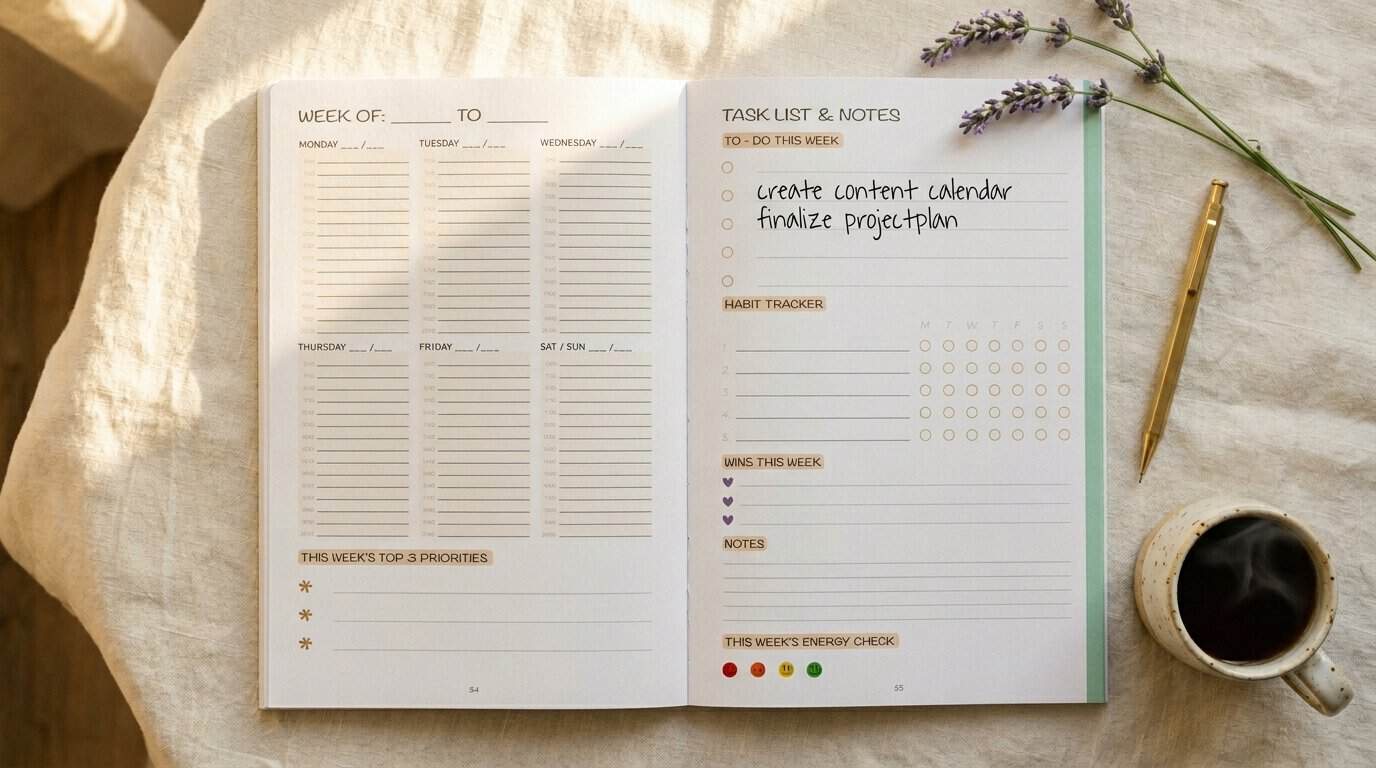
The Flowers ADHD Planner has a Weekly Energy Check built into every spread — so the question “what kind of week is this?” is already there, every week, before the task list starts. It also has a 5-line to-do block (not 25), a dedicated Rest Day section, and a Dopamine Menu on pages 8–9 for the moments mid-week when you’re stuck and can’t generate options.
Undated — start any week, pause any week, come back without a backlog of guilt.
Designed in Europe. Made for brains that don’t fit neat boxes.
Pink Lobster Creatives is run by Liesbeth, a surface pattern designer building the tools she wished she’d had 10 years ago. Everything here comes from lived experience rather than a medical qualification. Nothing on this blog is a substitute for advice from your doctor, therapist, or ADHD coach. Strategies that work for one person with ADHD may not work for another. If something resonates, take it. If it doesn’t, leave it.
Related reads:
ADHD All-or-Nothing Planning — And How to Break It
Brain Dump vs. To-Do List: Which One Your ADHD Brain Actually Needs
ADHD Overwhelm? 3 Things That Actually Helped Me
The ADHD Sunday Reset
Leave a Reply