
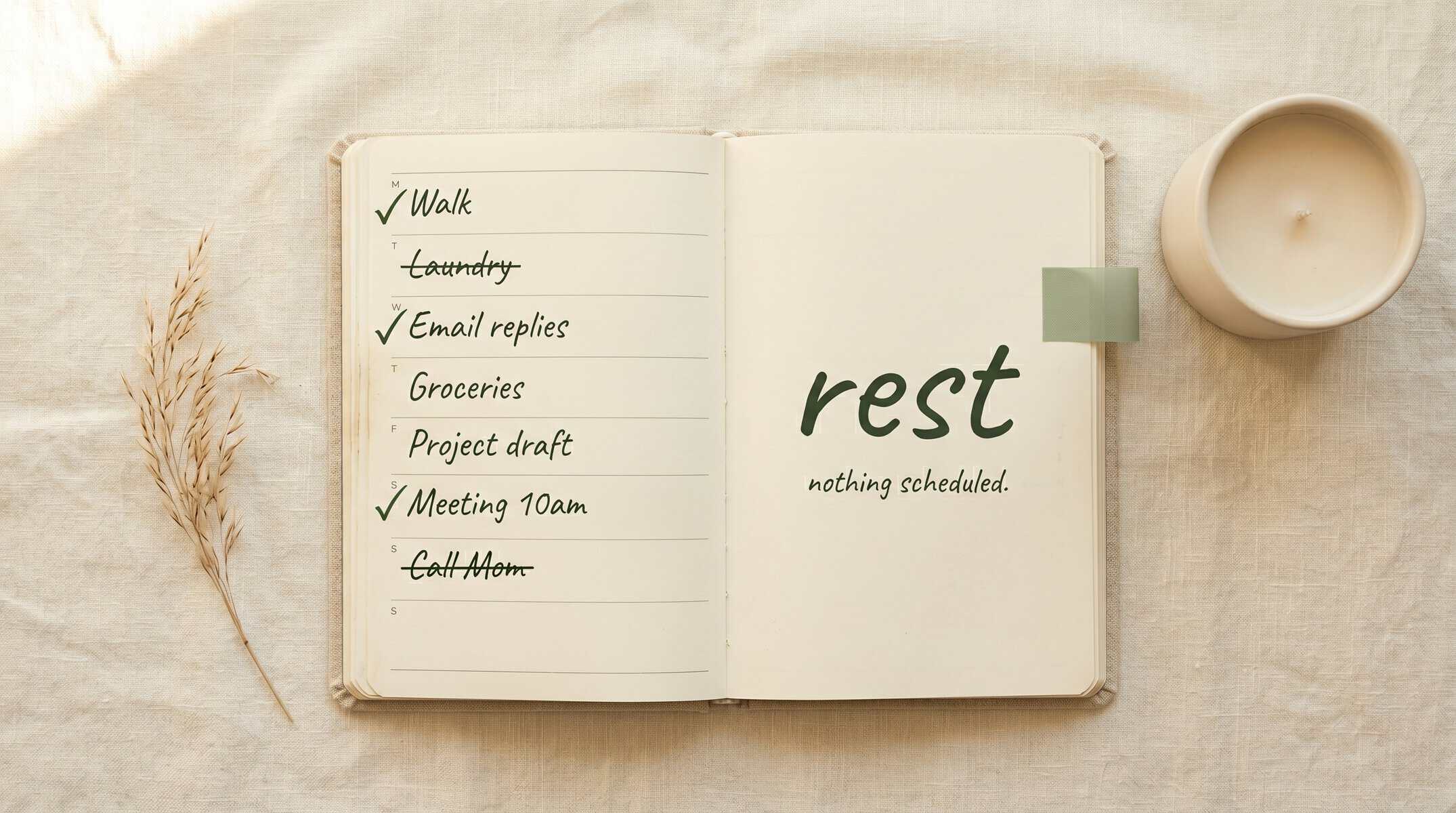
Skipping rest doesn’t make you more productive. For ADHD brains, it just means the crash tends to come later — and harder. Rest isn’t a reward at the end of a productive week. It’s a structural requirement for a system that burns more energy than most people realise. The problem isn’t that ADHD brains need more rest. It’s that rest, for most of us, is the first thing cut when the week gets full — and the last thing we give ourselves permission to take.
What “Rest” Usually Looks Like for ADHD Brains (And Why It Doesn’t Work)
Most ADHD adults don’t lack rest — they lack restorative rest. There’s a difference between stopping and actually recovering. What often happens instead:
- Scrolling for two hours and standing up feeling more depleted than before
- “Resting” while mentally rehearsing everything you should be doing instead
- Falling into hyperfocus on something low-priority because your brain needed stimulation, not downtime
- A Sunday where you “didn’t do much” but somehow feel exhausted by Monday
- Guilt-rest: time off that’s spent feeling guilty about taking time off — which is not rest. It’s just suffering without output.
The common thread: none of these were planned. They were what happened when the system ran out. That’s not recovery. That’s collapse.
Why ADHD Brains Need Rest Built In — Not Left Over
Most productivity advice treats rest as what’s left after tasks are done. Finish the list, then rest. Earn the weekend. Clear the inbox, then take a break.
For neurotypical brains with functional self-regulation, that can work. The brain sends a signal when it’s depleted and responds to it. For ADHD brains, two things often break that system:
- The depletion signal can arrive late — or not at all. Hyperfocus may mask exhaustion. You can run at 130% until the moment you can’t — and there’s often no gradual warning. The ADHD brain doesn’t always say “you’re getting tired.” Sometimes it just says “fine, fine, fine — then nothing.”
- Unscheduled rest can become unstructured time — which many ADHD brains find difficult. Without a plan, “free time” may turn into paralysis, doomscrolling, or a low-grade guilt spiral. Not restorative. Not restful. Just uncomfortable.
The fix isn’t better willpower. It’s taking rest out of the “leftover” column and putting it in the plan — the same way you’d put a meeting or a deadline.
What a Planned Rest Day Actually Looks Like
Not a spa day. Not a productivity-free weekend where you somehow clean the entire house. A planned rest day is simple: a block of time where no tasks are scheduled, and you’ve decided in advance what “rest” means for you.
That second part matters. “Rest” is vague. ADHD can struggle with vague. Some options — pick what actually restores you, not what sounds like rest should look like:
- Active rest: a walk, time outside, slow cooking something you like. Movement without outcome.
- Passive rest: couch, blanket, something low-stakes to watch or listen to. Permission to do nothing productive.
- Creative rest: drawing, making, tinkering — not for output. For the sake of the thing itself.
- Social rest: one person you don’t have to perform for. Not a dinner party. Not networking.
- Alone rest: if social energy is your main drain — door closed, phone on silent, no obligations.
The point isn’t the category. The point is that you’ve decided before the day arrives. A pre-decided rest day is more likely to be actually restful. An improvised one often isn’t.
How to Actually Build Rest Into the Week
Three things that make the difference between rest that happens and rest that gets cut:
- Schedule it first, not last. Rest put at the end of the week — “if I finish everything” — tends to get cut. Every time. Put it in the plan at the start of the week and protect it like an appointment you can’t move.
- Name it something specific. Not “free time” or “relax.” Those are too vague to protect. “Saturday afternoon — no tasks, dopamine menu” is a plan. “Some downtime at some point” is a wish.
- Don’t negotiate with it when the week gets full. Rest often looks like the most moveable item on the list. It can also be the load-bearing wall. When rest goes, executive function tends to follow — usually 48 hours later, at the worst possible moment.
One rule that often holds: if something has to give in a full week, it’s a task — not the rest. Most tasks can move. Your nervous system is less flexible.
The Permission You’re Actually Waiting For
For a lot of ADHD adults, the real barrier isn’t scheduling. It’s a deeply held belief that rest has to be earned. That productivity comes first, then rest. That doing nothing is only acceptable after doing everything.
That belief doesn’t come from nowhere. Most of us grew up in systems — school, work, family — that rewarded output and treated rest as laziness. For ADHD brains, that shame can run deep. We already feel like we’re falling behind. Taking rest can feel like falling further.
The reframe that tends to hold: rest is not a reward. Rest is part of the system. A car doesn’t earn fuel. A phone doesn’t deserve charging. Rest is how the ADHD brain can replenish the exact resources — executive function, emotional regulation, working memory — it needs to do everything else. Cutting rest to get more done is like burning the fuel to pay for the fuel. It tends not to add up.
You don’t need to earn rest. You need to plan it. And if a planned rest day still keeps turning into a catch-up day anyway, that’s usually ADHD rest guilt doing the overriding — worth a closer look on its own.
The Short Version
- ADHD brains often don’t get reliable depletion signals — the crash can come without warning.
- Unplanned rest often isn’t restorative — it can become unstructured time, which many ADHD brains find difficult.
- Rest built into the week is a structural choice, not a treat.
- Decide what rest means for you before the day arrives — vague tends to be the enemy.
- Schedule rest first. Protect it like an appointment. Don’t negotiate when the week gets full.
- Rest isn’t earned. It’s required.
A Planner With Rest Built Into Every Week
Most planners are designed as if productivity is the goal and rest is the gap between productive periods. Every page is a list of things to accomplish. There’s no space for “nothing scheduled” — because the assumption is that nothing scheduled is a planning failure.
The Flowers ADHD Planner works the other way. The weekly spread has a dedicated rest day section — an actual space to mark and protect. The Energy Check at the start of each week acknowledges that some weeks are recovery weeks, and the plan should reflect that. The Dopamine Menu spread gives you pre-decided options for what to do on rest days — so you’re not staring at a free afternoon wondering what actually restores you. And it’s undated, so a week of genuine rest doesn’t leave seven dated pages staring at you like a failed promise.
Designed in Europe. Made for brains that need structure for rest as much as for tasks.
Pink Lobster Creatives is run by Liesbeth, a surface pattern designer building the tools she wished she’d had 10 years ago. Everything here comes from lived experience rather than a medical qualification. Nothing on this blog is a substitute for advice from your doctor, therapist, or ADHD coach. Strategies that work for one person with ADHD may not work for another. If something resonates, take it. If it doesn’t, leave it.
Related reads:
Leave a Reply