
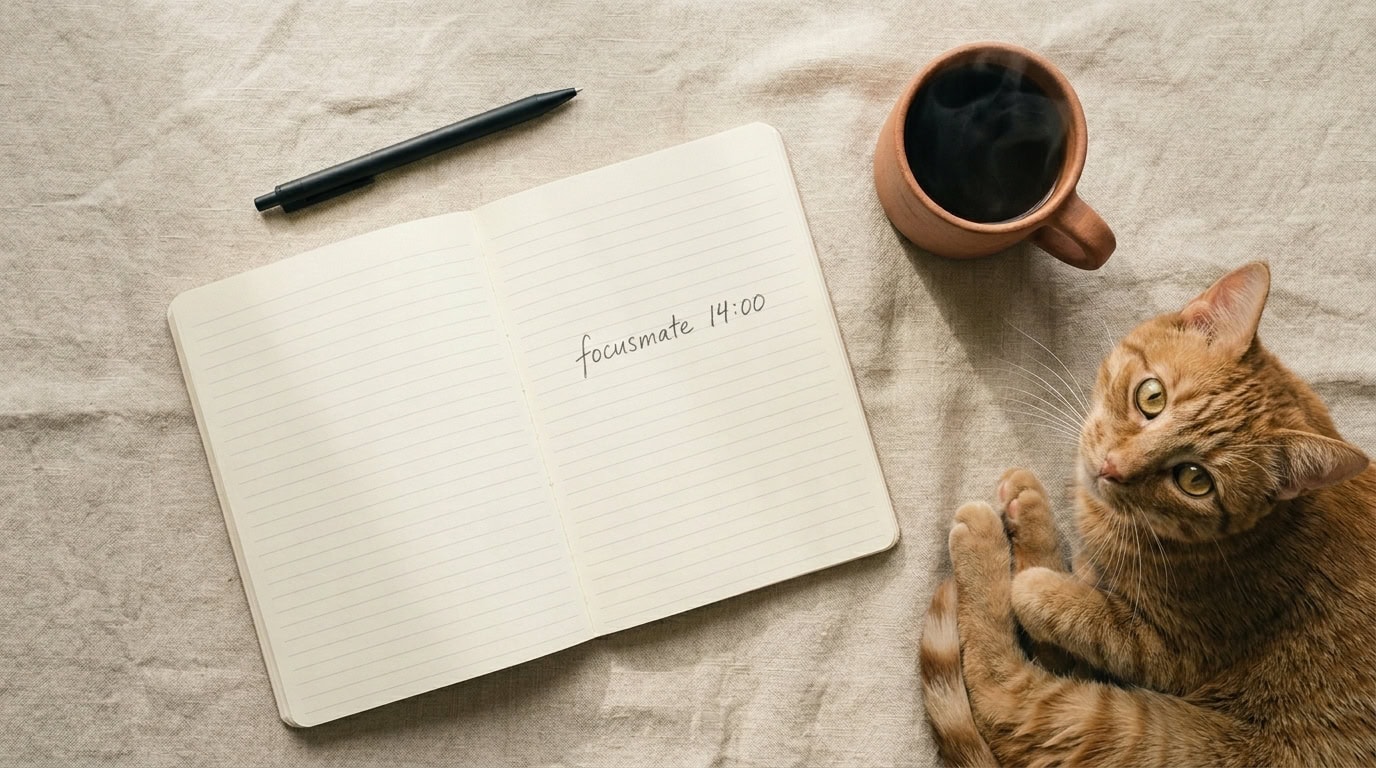
Body doubling is one of the few ADHD strategies many people consistently report as helpful. The idea is simple: another person being present, even passively, can lower the activation cost of a task you’ve been avoiding. Many people find that having a witness — any kind of witness — makes starting easier.
The standard advice is to “find a body double” — usually pictured as a roommate, a partner, or a coworker at the next desk. That advice quietly assumes everyone has access to one.
If you live alone, work from home alone, or have a household that’s never quiet at the right moments, the standard version doesn’t apply. The mechanism still works — you just need a different source of presence. Here are five that do.
1. Asynchronous body-doubling apps (when scheduled)
There are now apps purpose-built for this. Focusmate is the most established: 25- or 50-minute sessions with one other person on video, no talking, both working on your own thing. You say at the start what you’ll do, then you both do it, then you say at the end whether you got there.
The check-in at the start is doing a specific thing — it makes the task said out loud, which many ADHD brains find is the hardest part of task initiation. The body double is the witness; saying it is the start.
Flow Club is similar with a slightly different rhythm (group sessions, music, ambient hosting). Both work. Both are paid. Both are worth it if even one session a week unsticks something you’ve been avoiding.
2. Live-streamed work or study videos (passive presence)
If a live human on video is too much, a recorded human pretending to be live is often enough. YouTube has a deep catalog of “study with me” and “work with me” videos — sometimes 4 to 8 hours long, sometimes with a Pomodoro structure, often with ambient cafe sound.
The trick: pick one with a person visible at a desk. Not just a fireplace or rain video — those are background. You need a presence. Many people find their brain doesn’t seem to care that the presence is recorded.
This is the lowest-friction body double. No scheduling, no commitment, no other person to disappoint if you flake. Open the video, put it on a second screen or phone propped up, work next to it.
3. Phone call with a friend who’s also doing something (mutual silence)
If you have one friend who’s also ADHD or works from home alone, this one is free and often works better than the apps. Call them. Say “I’m doing X for the next 30 minutes, you?” They name their thing. Then both of you put the phone on speaker and don’t really talk.
The presence is the line being open. Occasional clicks of someone else’s keyboard. The “are you still there” check every 15 minutes. Talking is allowed but not required.
The structure is co-presence, not conversation. The first time you do it feels strange. By the third time it’s the most reliable focus tool you have.
4. Cafe or library work (anonymous co-presence)
The oldest version of body doubling. A room full of strangers doing their own thing, not paying attention to you.
What makes this work for ADHD brains: the social cost of obviously procrastinating around strangers is slightly higher than around no one. You’re not going to scroll Instagram in a cafe the way you scroll it at home. You’re not going to give up after 20 minutes and reorganise your desk. The presence of witnesses, even uninterested ones, creates a small accountability that holds you in the chair.
Cost: a coffee. Friction: getting there. But if the freeze keeps winning at home, this is sometimes the only thing that breaks it.
A library is the no-cost version. Bonus: less sensory load (no music, no chatter) — useful if sensory overwhelm is part of what’s making concentration hard.
5. Pet next to you (animal presence counts more than people think)
Underrated. A pet in the room — a dog asleep at your feet, a cat on the desk, a rabbit in its enclosure across the floor — counts as presence to the brain.
The research on this isn’t quite as strong as for human body doubling, but the lived-experience evidence is unambiguous. Many people work better with a pet nearby. The presence is unjudging, the warmth is regulating, and there’s a small unspoken accountability (“I will not abandon this session and leave you alone in this room”).
Pets can also become a passive timer. The dog needs walking at 4pm. The cat starts demanding dinner at 6. The day stops being shapeless and gains a couple of external anchors — small ones, but real.
If you don’t have a pet, this is not a reason to get one. Add a houseplant or two on the desk — same logic at a smaller scale. Many people find that having something else alive in the room reads as enough presence for the brain to settle.
What body doubling isn’t
A few things worth naming so they don’t sneak in as substitutes:
- Listening to a podcast is not body doubling. A podcast is an input, not a presence. It usually competes with the work, not supports it.
- Texting a friend “I’m working” is not body doubling. Without the open channel, you’re just narrating intention.
- A noisy household is not automatic body doubling. Random presence in motion is different from co-presence in stillness — the first is often a distraction.
Body doubling specifically needs another quiet presence — recorded, live, animal, or stranger — alongside the work, not in competition with it.
How the planner makes body doubling easier to schedule
The Flowers ADHD Planner has an hourly grid (6:00–20:00) on every weekly spread. A Focusmate session at 14:00, a cafe block from 10:00–12:00, a phone-double call at 16:30 — they get written into the grid with a name and a duration. Pre-committing on paper raises the chance the session actually happens.
The Energy Check at the start of the week is also useful here: low-battery weeks call for the lowest-friction body double (YouTube + a cat). High-focus weeks can carry the harder ones (cafe + Focusmate stacked).
Pink Lobster Creatives is run by Liesbeth, a surface pattern designer building the tools she wished she’d had 10 years ago. Everything here comes from lived experience rather than a medical qualification. Nothing on this blog is a substitute for advice from your doctor, therapist, or ADHD coach. Strategies that work for one person with ADHD may not work for another. If something resonates, take it. If it doesn’t, leave it.
Related reads:
Body Doubling for ADHD — The Underrated Tool Most People Don’t Know About
Task Initiation for ADHD — Why “Just Start” Doesn’t Work
Executive Dysfunction Tools That Actually Help
When the ADHD Brain Goes Offline
Leave a Reply