
The 20-Second Version
Time blindness isn’t a problem with time. It’s a problem with shape.
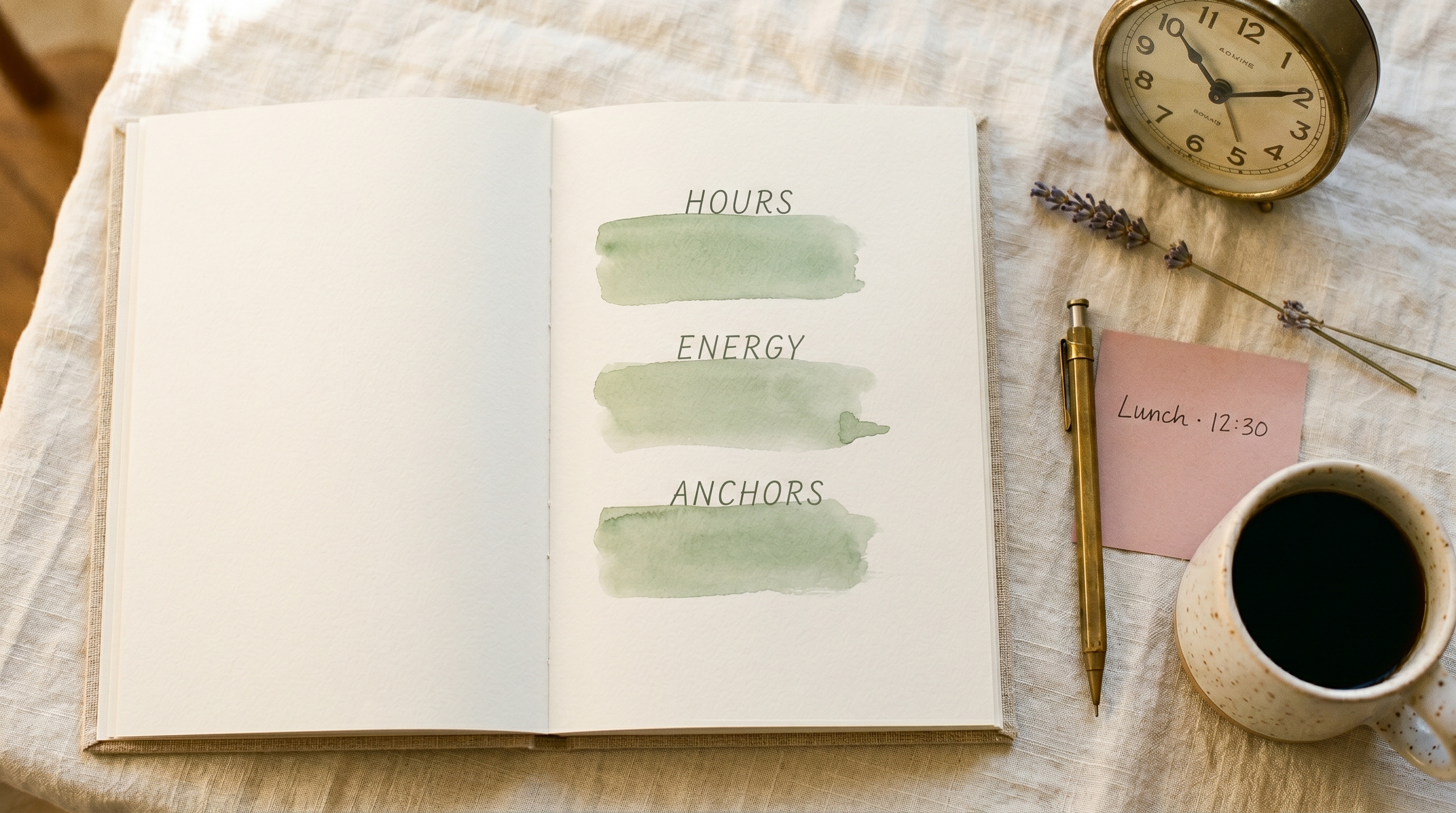
ADHD brains don’t feel hours. They feel energy, novelty, and anchors. Most planners give you hours and nothing else — so the day quietly stops matching the page by 11am.
The fix isn’t to throw the hourly grid out. The fix is to layer two more things on top of it: an energy reading for the week, and 1–2 fixed anchors for the day. Hours plus energy plus anchors. That’s the system.
What Time Blindness Actually Feels Like
You sit down at 9am to “answer one email.” You look up. It’s 11:20.
Or the opposite: you start a 25-minute task, check the clock convinced an hour has passed, and it’s been six minutes.
Or the most common one: you know you have “the afternoon” to do three things, and somehow none of them get done — not because you were avoiding them, but because the afternoon never converted into actual sequential time in your brain.
This isn’t a planning failure. It isn’t a willpower failure. It’s the ADHD experience of time being non-uniform. Some hours feel like ten minutes. Some ten-minute stretches feel like an entire afternoon. The clock and the brain don’t agree, and the planner — which is built around the clock — quietly stops being useful.
A lot of ADHD women describe this from lived experience long before they have language for it. The shame attached to it is the shame of “I had all day and I got nothing done.” The reframe is that your brain wasn’t running on the clock you were trying to plan against.
Why Hourly Planners Fail (On Their Own)
The classic weekly planner gives you a column per day, divided into one-hour rows from 9am to 5pm. Eight neat boxes. The implicit message: fill each box with a task, execute it during that hour, move on.
Three things break that for an ADHD brain:
1. The brain doesn’t believe the rows. A row labeled “10:00–11:00” is a visual placeholder, not a felt reality. ADHD attention doesn’t notice the row boundary the way the page assumes you will.
2. One slip cascades. Run 30 minutes over on the 9am task and the entire grid is now wrong. Not just the 9am task — every row below it. ADHD brains see “the plan is broken” and disengage from the whole page.
3. The grid has no shape. Tuesday 10am and Thursday 3pm look identical on the page, but they aren’t identical in your brain. Tuesday 10am might be a 90-minute deep-focus window. Thursday 3pm might be a 12-minute attention budget. The planner can’t tell the difference, so it asks the same thing of both.
Hourly grids aren’t wrong. They’re incomplete. The hour is one layer. The brain needs at least two more.
The 3-Layer Fix
Time blindness gets manageable when you stop trying to plan with one layer (hours) and start planning with three.
Layer 1 — Hours (the structure)
You still need an hourly framework. Not because the brain reads it, but because other people’s calendars run on hours. Meetings, school pickups, calls, deadlines — they all live on a clock. Layer 1 is the bones.
What this looks like in practice: an hourly weekly spread, 6am to 8pm, where you write in the things that are actually clock-bound (the 11am call, the 3:30 pickup) and leave the rest blank.
Layer 2 — Energy (the shape)
This is the layer most planners skip. Before you fill in the hourly grid, you mark the shape of the week at the energy level: which days are heads-down focus days, which are appointment-heavy, which are recovery.
This isn’t a daily prediction. It’s a weekly read. “Monday is heavy. Wednesday is for output. Friday is recovery.” That single line of context changes how you read the same hourly grid.
What this looks like in practice: a weekly Energy Check at the start of the week — 1–2 lines that name the shape. High / Medium / Low. Then when you look at Tuesday 10am, you read it as “Tuesday 10am on a high-focus week” not just “Tuesday 10am in a vacuum.”
Layer 3 — Anchors (the spine)
The last layer is 1–2 fixed events per day that the brain can feel — things with a body, a place, or a person attached to them. A morning routine. Lunch. A walk at 4pm. A weekly 6pm class.
ADHD brains lose the middle of the day, but they hold onto anchors. If you build the day around the anchors instead of around the hours, the day stops being one undifferentiated stretch and starts being three or four shaped chunks: before-anchor, between-anchors, after-anchor.
What this looks like in practice: 1–2 anchored events per day on the hourly grid, with the work designed to fit around them, not over them.
The combined system: hours for the bones, energy for the shape, anchors for the spine. None of the three works on its own. All three together is what holds up against time blindness.
Why This Works When Hourly Alone Doesn’t
Three things shift when you add layers 2 and 3:
You stop reading the grid as a contract. You read it as a sketch. The 10am row isn’t a promise that you’ll be doing the 10am task at exactly 10am — it’s a sketch of “this fits into the morning, on a week shaped like this, before the lunch anchor.”
A 30-minute slip stops cascading. Because the day isn’t built on rigid rows, a slip in one block doesn’t invalidate the next four. The anchors hold. The energy band holds. You re-shuffle inside one chunk, not the whole day.
Tuesday 10am stops looking like Thursday 3pm. The energy layer makes the same hourly box mean different things on different days. You stop expecting the same output everywhere.
The Method, Step by Step
You can do this on any planner that has an hourly spread, an energy check, and room for anchors. Here’s the order.
Sunday evening (10 minutes)
- Read the week. Look at the next 7 days. Mark each day as H / M / L (high / medium / low energy). This is your guess — it’s allowed to be wrong.
- Mark the anchors. For each day, write the 1–2 things that will happen no matter what — meals, school runs, a class, a standing meeting. These are your spine.
Each morning (3 minutes)
- Read your shape. Look at today’s H/M/L. Look at today’s anchors.
- Write 3 things on the hourly grid. Just three. Slot them around the anchors and respect today’s energy. High day = one demanding task in your peak window. Low day = one demanding task at all, or zero.
When the day slips (it will)
- Re-shuffle inside the chunk, not across the day. The 10am task didn’t happen? Move it to the next “before lunch” slot. Don’t redraw the whole afternoon.
That’s it. Five steps. No app. No new framework. Just the three layers, in order.
Common Mistakes That Re-Break the System
Even with the 3-layer fix, there are three patterns that quietly collapse it back into a one-layer hourly grid.
1. Skipping the weekly Energy Check. This is the most common one. Without the energy layer, the hourly grid is back to being one-dimensional. The Energy Check takes 60 seconds. Don’t skip it.
2. Putting too many anchors in. An “anchor” is something that will happen — meals, fixed appointments, school pickup. If you’re listing 8 anchors in a day, those are tasks, not anchors. Two per day is the cap.
3. Treating the hourly rows as deadlines. The grid is a sketch, not a contract. The 10am task doesn’t fail at 10:31. It just moves to the next slot inside the same chunk.
What About Timers, Apps, and Visual Clocks?
These tools all help — but they help with a different layer of time blindness, not this one.
Visual clocks (like a Time Timer): good for inside a single task. Helps the brain feel a 25-minute window. Doesn’t fix the day-shape problem.
App reminders / alarms: good for snapping you out of a hyperfocus tunnel. Don’t replace planning. Replace forgetting.
Pomodoro timers: good for the “I can’t start” moment. Useful inside a task, not for shaping the day.
The 3-layer system is the day-shape fix. Timers and alarms are the inside-the-task fix. You can use both. They don’t compete.
The Short Version You Can Actually Remember
- Time blindness isn’t a time problem. It’s a shape problem.
- Hourly grids alone fail because they have no energy layer and no anchors.
- The fix is three layers: hours + energy + anchors.
- Sunday: mark each day H/M/L and write the day’s 1–2 anchors.
- Each morning: read your shape, then write 3 things around the anchors.
- A slip moves inside a chunk, not across the whole day.
That’s the whole method.
A Planner That Already Holds These Layers
Our Flowers ADHD Planner is built with all three layers in the same spread. Each weekly page has the hourly grid (6am–8pm, Monday through Sunday) for layer 1, a built-in Energy Check for layer 2, and room for the 1–2 daily anchors that make layer 3 work. Plus a To-Do block (5 lines, not 25) and a Wins-This-Week space, because the day-shape system needs somewhere small to land — not somewhere big to disappear into.
Undated, so a missed week doesn’t break it. Designed in Europe. Made for brains that don’t fit neat boxes.
Pink Lobster Creatives is run by Lies — a surface pattern designer building the tools she wishes she’d had 10 years ago. Everything here comes from lived experience, not a medical qualification. Nothing on this blog is a substitute for advice from your doctor, therapist, or ADHD coach. If something resonates — take it. If it doesn’t — leave it.
Related reads:
Leave a Reply